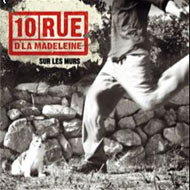
 10 Rue d'La Madeleine is Andy Burke (drums), Bill Nuggets (guitar), Mike Flanagan (bass), Peter Goldberg (violin), Eddy 'Ed' Flint
(clarinet) and Brad Bronsein (vocals).
10 Rue d'La Madeleine is Andy Burke (drums), Bill Nuggets (guitar), Mike Flanagan (bass), Peter Goldberg (violin), Eddy 'Ed' Flint
(clarinet) and Brad Bronsein (vocals).The Folia theme is most often used in classical music in a rather polite and learned style. However here we can enjoy another feature of the Folia in a very modern agressive 'anarchist-rock-style'.
Vive la commune by 10 Rue d'La Madeleine
|
It's an obstinate theme since centuries and we didnt want it to be forgotten...and you must know why... of course you can use the song for your site and you are right there are not often rock band which use it...Lets call it Barock!!!lol
- 10 Rue d'La Madeleine 'Sur les Murs'
- Title: Vive la commune
- Released 2006 by Demain La Veille compact disc DLV006
- Duration: 3'35"
- Recording date: April 2005 in 'Studio Cox in Hell'
- More about this band at their website http://www.10rue.com

In the magazine Piano International May/June 2007 Dmitry Rachmanov analyses a host of recordings of this work.
Florence Anne Mclean wrote a thesis with the title Rakhmaninov's "Corelli" Variations: new directions
 |
The sheet music |
 |
Duration: 1'42", 02 kB. |
Santiago Rodriguez plays all variations
|
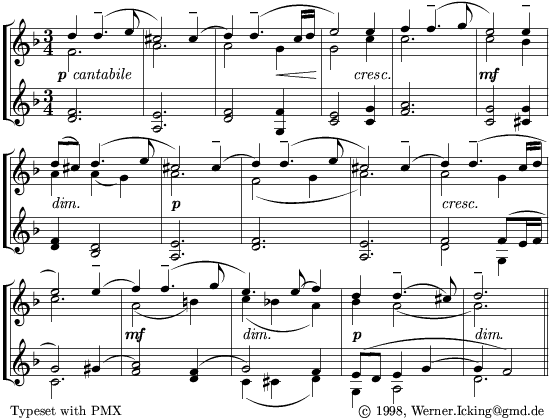
| Theme of Variations on a theme of Corelli | Belwin Mills edition, 1959 p. 2 |
|---|---|
 |
|
- Ashkenazy, Vladimir (piano solo) 'Variations on a theme of Corelli, Op. 42'
- Released 1957 by Angel LP ANG 35647
- Recording date: late 1957 in Berlin
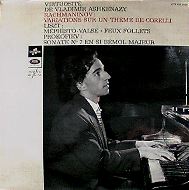
- Ashkenazy, Vladimir (piano solo) 'Rachmaninov: Variations on a Corelli theme,
Liszt: Mephisto waltzes, Feux, Follets Prokofiev: Sonate No. 7'
- Title: Variations on a Corelli Theme Op. 42
- Released by Columbia, France LP FCX 30336
- Series: Plaisir Musical Series
- Ashkenazy, Vladimir (piano solo) 'Etudes-Tableaux, Op. 39 and Variations on a theme by Corelli, Op. 42'
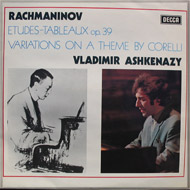 John Culshaw wrote about the variations as introduction for this recording:
The Corelli Variations is not only his last work for solo piano, but in fact the only work for solo piano composed during his twenty six years of exile in the USA. It was first played by him in New York 1932. The theme is not actually by Corelli. It is an ancient dance melody called La Folia which has been quoted or varied by various composers down the ages, including Bach, Cherubini and Liszt.
Rachmaninov uses the theme as it appears in Corelli's twelfth violin Sonata, and his set of twenthy variations, though beautiful and compelling in it's own right, can be seen as a sort of study or preparation for the immensely succesful Rhapsody on a theme by Paganini for piano and orchestra which appeared two years later: certainly variations four and eight seem to anticipate passages in the later work. The selfdoubt which haunted Rachmaninov throughout his life led him to indicate that variations eleven, twelve and nineteen may be omitted if desired, though they are rightly included in this recording. Otherwise, each variation sets off its neighbours by neat contrasts of mood or colour. There is a passage marked 'Intermezzo' after variation thirteen which is really a sort of cadenza; and the work ends with a reflective, slow coda.- Title: Variations on a Theme by Corelli, Op. 42
- Released 1972 by Decca LP SXL 6604
- Duration: 19'56"
- Recording date: not mentioned in the documentation
- Ashkenazy, Vladimir (piano solo) 'Corelli's variations Op.42, Etudes-tableaux Op.39'
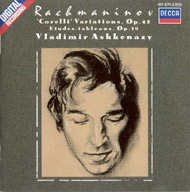
- Released 1988 by Decca compact disc MCPS417 671-2
- Duration: 19'56" and every variation indexed (22)
- Ashkenazy, Vladimir (piano solo) 'Concertos pour piano (intégrale), rhapsodie sur un thème de Paganini'
- Released by TRIO compact disc 3 cd-box (track 2 cd 3)
- Duration: unknown
- Recording date: unknown
- Ashkenazy, Vladimir (piano solo) 'Rachmaninov: Music for 2 Pianos'
- Released by Decca London compact disc 2-cd-box
- Duration: unknown
- Recording date: unknown
- Babinsky, Margarete (piano) 'Rachmaninov: Variations on a Theme of Corelli, Morceaux de fantaisie, Suite No. 2, 6 Duets (Busch, Babinsky)'
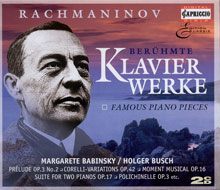
- Title: Variations on a Theme of Corelli, Op. 42
- Released by Capriccio 2 cd-set C49295
- Duration: 25'43"
- Recording date: unknown
- Bärtschi, Werner (piano) 'La Folia'
- Title: Variationen für Klavier über ein Thema von Corelli (1932)
- Released 1983 by PAN LP ordernumber 130 051
- Duration: 18'41"
- Recording date: February 2nd in Thun Switserland, 1982
- See also the page Recommended Folia-recordings
- Bax, Alessio (piano solo) 'Baroque Reflections'
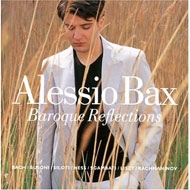
- Released by Warner Classics compact disc
- Duration: unknown
- Recording date: unknown
- Belwin Mills Publishing Corp.
- Title: to Fritz Kreisler: Variations on a theme of Corelli, Op. 42
- Published by Belwin Mills Publishing Corp. Melville N.Y. 1959
- Score 26 p. 28cm
- Publisher No. F2041
- Biret, Idil (piano solo) 'Rachmaninov: Piano Works'
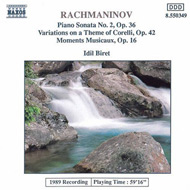
- Released by Naxos compact disc ordernumber 8.550349
- Duration: unknown (all variations indexed)
- Recording date: 1989 location unknown
- Berman, Lazar (piano solo) 'Prelude cis-Moll op. 3 Nr 2., prelude fis-Moll,
op. 23 NR 1, prelude D-Dur op. 23 Nr 4, prelude gis-Moll op. 32 Nr. 12,
prelude h-Moll op 32 Nr. 10, prelude B-Dur op. 23 Nr. 2, Variationen
über ein Thema von Corelli op. 42'
Edition used for recording: Russischer Staatsverlag- Released 1980 by Deutsche Grammophon LP 2531 276
- Released also in cassette 3301 276
- Bonn, James (Bosendorfer piano) 'Klavier Variations on La Follia'
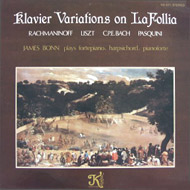
Variations on a Theme of Corelli by James Bonn
Duration: 19'05" direct link to YouTube
© 1982 by James Bonn
Maurice Hinson wrote for the Viny recording:
Rachmaninoff completed his Variations on a Theme of Corelli Op. 42 on June 19, 1931. This is not only his last work for solo piano but it is the only work for solo piano composed during his twenty-six years of exile in the U.S.A. it is dedicated to Fritz Kreisler and Rachmaninoff first played it in Montreal on October 12, 1931.
This set of variations represents the second time Rachmaninoff .had expressed himself in this form; the first was the Variations on a Theme of Chopin, Op. 22, composed during 1902-1903. He was to use the form one more time in the famous Rhapsody for Piano and Orchestra (on a theme of Paganini) Op. 43 composed during 1934.
Rachmaninoff wrote Nicholas Medtner about the work on December 21, 1931, from New York: "I am sending you my new Variations. I've played them here about fifteen times, but of these fifteen performances, only one was good. The others were sloppy. I can't play my own compositions! And it's so boring! Not once have I played these all in continuity. I was guided by the coughing of the audience. Whenever the coughing increased I would skip the next variation. Whenever there was no coughing I would play the proper order. In one concert, I don't remember where - - some small town, the coughing was so violent that I only played ten variations (out of twenty). My best record was set in New York, where I played eighteen variations."
The theme that inspired this set is not by Corelli but is by now our ancient and familiar dance melody Ia Folia. Rachmaninoff uses the theme as it appears in Corelli's twelfth violin Sonata, and his set of twenty variations, though beautiful and compelling in its own right, can be seen as a sort of study or preparation for the immensely successful Rhapsody on a Theme by Paganini for piano and orchestra which appeared two years later: certainly variations four and eight seem to anticipate passages in the later work. The self-doubt which haunted Rachmaninoff through his life led him to indicate that variations eleven, twelve and nineteen may be omitted if desired, though they are rightly included in this recording. Otherwise, each variation sets off its neighbors by neat contrasts of mood or color. There is a passage marked Intermezzo after variation thirteen which is really a sort of cadenza; and the work ends with a reflective, slow coda. The variations are organized into an entirely logical structure, with a series of swift variations (16-20) reaching a dramatic climax before the pensive coda. The rhythms are more vital than in his mature Russian works (apparent, for example, in the incisive fifth variation, with its frequently changing time-signature) and the harmonies are more adventurous, more pungent, particularly in the slower Nos. three, eight, and nine, and in the masterly shift of key from D minor to D flat major in variation fourteen, after the mild turbulence of the Intermezzo. All of these characteristics constitute a new, more subtle mode of expression, and Vladimir Wilshawk rightly commented on the difference that had overcome his style since the more extrovert Etudes-Tableaux (during a performance on which Rachmaninoff had broken a string on the piano). Rather like his last set of songs, the Corelli Variations leave a feeling of regret that Rachmaninoff never again wrote a solo piano piece and allowed the attractive features of this later style to develop fully.- Title: Variations on a Theme of Corelli
- Released 1982 Klavier Records LP KS-571
- Duration: 19'05"
- Recording date: not indicated in the documentation
- See also the page Recommended Folia-recordings
- Bonn, James (piano) 'Recorded live'
- Title: Variations sur un theme de Corelli / Rachmaninoff
- Released 1977 by unknown company sound cassette (analog, stereo)
- Duration: unknown
- Recording date: February 1, 1977 in Heeren Recital Hall, Southern Baptist Theological Seminary
- Cherkassky, Shura (piano-solo) 'Franck, Grieg, Messiaen, Rachmaninov'
- Released 1987 by Nimbus Records compact disc NI 5090, distributed by A & M Records
- Duration: 17'33"
- Recording date: February 9, 1987 at Wyastone Leys
- Cherkassky, Shura (piano-solo) 'Shura Cherkassky: 1909-1995'
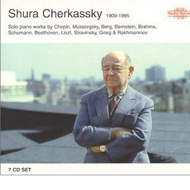
- Released 1987 by Nimbus Records 7-cd-box
- Duration: 17'33"
- Recording date: February 9, 1987 at Wyastone Leys
- Collard, Jean-Philipe (piano-solo) 'Rhapsodie sur un thème de Paganini, variations sur un thème
de Corelli, sonate no 2, e´tudetableaux, 5 preludes, moment musical'
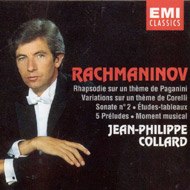 Barry Millington wrote for the slipcase:
The Variations on a theme of Corelli (actually a traditional tune called La Folia used by Corelli in his twelfth violin sonata) was Rachmaninov's last work for piano solo (1931). Though as skilfully constructed set of variations in its own right, it have(sic!) often been seen as a precursor of the Rhapsody on a them of Paganini, which followed three years later, and certainly there are frequent pre-echoes of that perennial favourite in the Corelli Variations, as can be heard with the benefit of their juxtaposition here.
- Released 1989 (compilation and remastering) by EMI Classics (EMI Music France) 2-set compact disc 7243 5 6967724
- Duration: 17'30"
- Recording date: unknown (1972-1989?), place of recording unknown
- Berman, Lazar (piano-solo) 'Rachmaninov: Paganini Veriations, Corelli Variations, 6 Preludes'
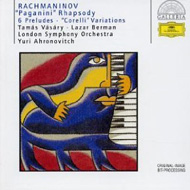
- Title Corelli variations
- Released by DGG compact disc
- Duration: unknown
- Recording date: unknown
- Demidenko, Nicolai (piano-solo)
- Recorded and broadcasted live for BBC 3 radio
- Duration: 17'49"
- Recording and broadcasting date: October 20, 1998, Studio One of the Broadcasting house in front of a live audience, Belfast
- Producer Bill Lloyd
- Glemser, Bernd (piano-solo) 'Rachmaninov: Paganini Corelli Variations, Piano Sonata no. 2, Morceaux de fantaisie'
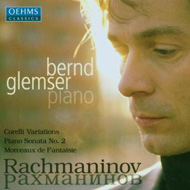
- Title Corelli variations
- Released by OEHM Classics compact disc OC 558
- Duration: unknown
- Recording date: unknown
- Grimaud, Hélène (piano-solo) 'Piano concerto no. 2. Prelude op 32 no 12, Etudes-tableaux op 33 no 1, 2, 9 and Variations on a theme of Corelli op. 42'
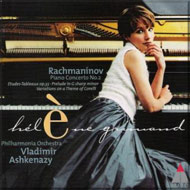
Andreas Wehrmeyer wrote for the slipcase:Through his work with the violinist Fritz Kreisler (a partnership that produced a whole series of gramophone recordings) he had got to know the violin music of Arcangelo Corelli, one of whose themes appealed to him so much that in 1931 he used it as the basis of a set of piano variations, his Variations on a Theme of Corelli op. 42. In fact, the theme derives from an old Iberian folkson, but what matters more is that Rachmaninov got to know it in Corelli's melancholy guise.
The piano writing in this late work is a little stricter and more translucent than in the composer's earlier piano pieces. As a whole these variations are a fine example of Rachmaninov's incipient late style and, as such, a model for the pieces that he wrote during the summer months between now and his death in the United States in 1943.- Released 2001 by Teldec compact disc CD 8573-84376-2
- Duration: 17'37"
- Recording date: January 29-30, 2001 at Teldec Studio, Berlin, Germany
- Jones, Martin (piano-solo) 'Rakhmaninov: Corelli Variations/Moments Musicaux'
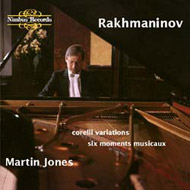
- Title: Corelli variations
- Released by Nimbus compact disc 4cd-box
- Duration: unknown
- Recording date: unknown
- Keene, Constance (piano-solo) 'Constance Keene plays variations'
- Released 1982 by Protone Records Los Angeles LP PR 156
- Duration: 17'04"
- Recording date: unknown at RCA, New York with DBX
- Kern, Olga (piano-solo) 'Corelli variations, Transcriptions'
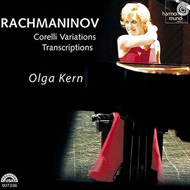
- Released 2004 by Harmonia Mundi USA compact disc HMU 907336
- Duration: 18'53"
- Recording date: August 2003 at Skywalker Sound, a Lukas Film Limited Company, Californiam USA
- Lill, John (piano-solo) 'Rakhmaninov: Piano Concertos 1-4, Symphonies 1-3, Orchestral Works'
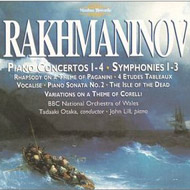
- Released by Nimbus compact disc 6cd-box
- Duration: unknown
- Recording date: unknown
- Lill, John (piano-solo) 'Rakhmaninov: Oeuvres pour piano'
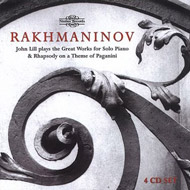
- Released by Nimbus compact disc 4cd-box
- Duration: unknown
- Recording date: unknown
- Lill, John (piano-solo) 'Rakhmaninov: Oeuvres pour piano'
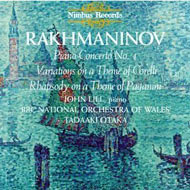
- Title: Variations on a theme of Corelli
- Released by Nimbus compact disc
- Duration: unknown
- Recording date: unknown
- Lugansky, Nicolai (piano-solo) 'Piano Sonata No. 2, Corelli Variations'
- Released 1993 by Vanguard compact disc Classics 899009
- Duration: 19'57" and every variation indexed (22)
- Recording date: January 26/28, 1993 in 'De Doopsgezinde Kerk', Amsterdam.
- Lugansky, Nicolai (piano-solo) 'Piano Sonata No. 2, Corelli Variations'
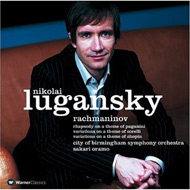
- Released unknown year by Warner Classics
- Duration: 19'57" and every variation indexed (22)
- Recording date: January 26/28, 1993 in 'De Doopsgezinde Kerk', Amsterdam.
\ - Marshev, Oleg (piano-solo) 'Serrgei Rachmanonov, ariations on a Theme of Corelli, Morceaux de fantaisie, Piano Sonata No. 2'
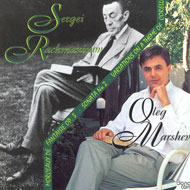
- Title: Variations on a theme van Corelli op. 42
- Released by Danacord compact disc DACOCD525
- Duration: Theme: Andante 1'04", Variation 1: Poco piu mosso 0'44", Variation 2: L'istesso tempo 0'41", 3: Tempo di menuetto 0'41", Variation 4: Andante 0'59", Variation 5: Allegro (ma non tanto) 0'21", Variation 6: L'istesso tempo 0'19", Variation 7: Vivace 0'24", Variation 8: Adagio misterioso 1'23", Variation 9: Un poco piu mosso 1'33", Variation 10: Allegro scherzando 0'33", Variation 11: Allegro vivace 0'23", Variation 12: L'istesso tempo 0,33", Variation 13: Agitato 0'36", Intermezzo 1'36", Variation 14: Andante (come prima) 1'10", Variation 15: L'istesso tempo 1'50", Variation 16: Allegro vivace 0'29", Variation 17: Meno mosso 1'25", Variation 18: Allegro con brio 0'36", Variation 19: Piu mosso, Agitato 0'31", Variation 20: Piu mosso 1'07", Coda: Andante 2'13"
- Recording date: unknown
- Mechetina, Ekaterina (piano-solo) 'Sergei Rachmaninov, Variations on a theme of Corelli, Piano transcriptions'
- Title: Variations on a theme van Corelli op. 42
- Released by Fuga Libera compact disc FUG 513
- Duration: unknown
- Recording date: unknown
- Michiels, Jan (piano-solo) 'la Folia'
- Title: Folias on a theme van Corelli op. 42
- Released 2001 by Radio Klara België compact disc MMP 025
- Duration: 15'57"
- Recording date: 2001
- Moyer, Frederick (piano-solo) 'Partita no. 5 in G major BWV 829, Johann Sebastian Bach &
Variations on a theme by Corelli opus 42, Sergei Rachmaninov'
- Released 1983 by GM Recordings LP
- Duration: 19'45"
- Recording date: unknown at Houghton Chapel, Wellesley College
- Nikolsky, Andrei (piano-solo) 'Rachmaninov piano works'
 Barbara Dobretsberger (translation by Deborah Holmes) wrote for the slipcase:
The thematic basis of the work is a Portuguese dance melody 'La Folia', which was used by several Baroque composers as a variation theme and features in one of Corelli’s sonatas. Amazingly, Rachmaninov does not vary the theme by creating virtuoso developments of the original. Corelli’s variations concentrated on individual harmonic developments, something that also characterises Rachmaninov’s later works. The compositional skill with which Rachmaninov treats the Baroque theme takes the wind out of the sails of critics who consider him to have been a briliant pianist but deny that he was a talented composer.
- Title: Corelli-Variations
- Released November 1991 by Arte Nova Musikproduktions GmbH compact disc Arte Nova classics 74321 27795 2
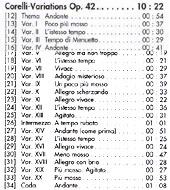
- Duration: 10'22" (officially but the performance has a duration of more than 15 minutes) all variations indexed
- Recording date: November 1991, Reitstadel Neumarkt, Oberpfalz.
- Nikolsky, Andrei (piano-solo) 'Rachmaninov piano works'
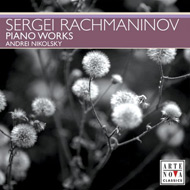
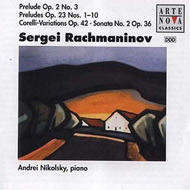
- Title: Corelli-Variations
- Released unknown year by Arte Nova Musikproduktions GmbH compact disc Arte Nova classics
- Duration: unknown
- Recording date: November 1991, Reitstadel Neumarkt, Oberpfalz.
- Osipovo, Irina (piano-solo) 'Vsesoëiìuznyaeikonkurs pianistov im. S.V.' (Parallel title on container: The All-Union
Rachmaninov Competition of Pianists)
- Title: Variaëtìsii na temu Korelli
- Released 1985 by Melodiëiìa, Moscow(?) as LP S10 22059 006
- Recording date: 1984 in Moscow.
- Parent, Christian (piano-solo) 'Variations sur un theme de Corelli op. 42: Serge Rachmaninov,
Estampes: Claude Debussy, Sonate pour piano no. 5 op. 53: Alexandre Scriabine'
- Released 197? by Duchesne LP DD 6014 Luik, Belgium
- Pizzaro, Arthur (piano-solo)
- Recorded live for the BBC radio
- Duration: 16'51"
- Recording date: February 1, 1999 in the Wickmahall in London, England
- Date of Broadcasting: England May 25, The Netherlands June 1 (Radio 4 time 2.00 am), program 'Euroclassic Notturno'
- Pletnev, Mikhail (piano-solo) 'Hommage à Rachmaninov'
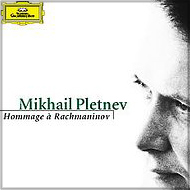
- Title: Variations on a Theme of Corelli, op. 42
- Released 1999 by Deutsche Grammophon compact disc 459 634-2
- Duration: 19'01". All variations nicely indexed
- Recording date: June 1998 at Villa Senar, the Rachmaninov family home near Lucerne in Switzerland
- Press, Roger (piano-solo) 'War Horses: Prokofieff, Debussy, Rachmaninoff'
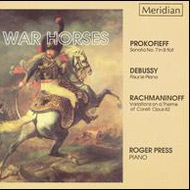
- Title: Variations on a Theme of Corelli, Op. 42
- Released by Meridian compact disc CDE 84160
- Duration: unknown
- Recording date: unknown
- Rodriguez, Santiago (piano-solo)
- Title: Variations on a Theme of Corelli, Op. 42
- Released 1995 by Elan (Riverdale, MD, USA) CD 82250
- Duration: 18'48"
- Recording date: June 1994 in John Addison Concert Hall, Fort Washington, MD
- Rudiakov, Shoshana (piano-solo) 'Piano Works by Chopin, Scriabin, Rachmaninoff'
- Released by Eroica compact disc
- Duration: unknown
- Recording date: unknown
- Shelley, Howard (piano-solo) 'Variations on a theme of Chopin op. 22, variations on a theme of Corelli op. 42,
Melodie in E major op. 3 nr. 3, scherzo from Mendelssohn's A Midsummer night's dream'
- Released 1981 by Hyperion LP A66009, re-released compact disc 1988 (AAD) CDA66009
- Duration: 18'30"
- Recording date: unknown in Conway Hall, London
- Shelley, Howard (piano-solo) 'The Complete Piano Music of Sergei Rachmaninov'
- Released by Hyperion compact disc 8 cd-box
- Duration: 18'30"
- Recording date: unknown in Conway Hall, London
- Slesarev, Yuri (piano-solo) Sochineniëiìa, pianoforte / S. Rakhmaninov'
(Parallel title on container: Pianoworks / S. Rachmaninov)
- Title: Variaëtìsii na temu Korelli
- Released 1981 by Melodiëiìa, Moscow(?) as LP S10 15671-2
- Recording date: 1980
- Duration: 16'11"
- Stott, Kathryn (piano solo) 'A Rachmaninov Collection'
- Released as compact disc
- Thibaudet, Jean-Yves (piano-solo) 'Rachmaninov: Piano Concerto 4, Variations on a Theme of Corelli, Piano Sonata No. 2,Prelude in C sharp minor'
 Anthony Short wrote for the slipcase:
The warm friendship between Rachmaninov and Fritz Kreisler resulted not in a violin work but in a set of solo piano variations dedicated to Kreisler, for whom Joseph Joachim had once predicted a solo career as a pianist. The unlikely collaboration between two such temperamentally different artists as the taciturn Rachmaninov and the amaible Kreisler yielded a series of remarkable recordings of Beethoven, Schubert and Grieg violin sonatas.
Kreisler introduced Rachmaninov to the tune 'La Folia', which he believed to be by Corelli, but which is of more ancient Portuguese origin. Rachmaninov was very taken with its potential for variation treatment, and during the summer of 1931 he composed the 'Variations on a Theme of Corelli'. These mark a return to the creativity that had deserted him following the cool reception of the Forth Concerto, yet for all their clarity of texture (a foretaste of the 'Paganini' Variations), the 'Corelli' Variations were again largely misunderstood by audiences. Rachmaninov regarded this reception with disdain and in December 1931 wrote to Medtner: 'I've played them about fifteen times, but ... not once have I played them in full. I was guided by the audience's coughing. When the coughing increased I skipped to the next variation. When there was no coughing I played them in the proper order. At one concert ... the coughing was so violent that I only played ten variations out of twenty'. My record is in New York, where I managed eighteen. Rachmaninov's continued disillusionment meant that he never again attempted a large-scale work for solo piano.- Released 1998 by Decca compact disc 458 930-2
- Duration: 18'10"
- Recording date: January 1996 in Severance Hall, Cleveland, Ohio
- Hamburg Steinway D 0250 piano
- Viardo, Vladimir (piano-solo) 'Rachmaninoff: Variations; Medtner: Sonata in A minor; Sonata Reminiscenza; Canzona Matinatal; Sonata Tragica'
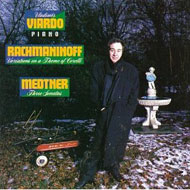
- Released by Nonesuch Records compact disc
- Duration: unknown
- Recording date: unknown
- Wagner, Vanessa (piano-solo) 'Variations'
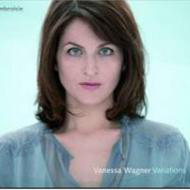
- Released 2008 by Naïve: compact disc AM134
- Duration: 19'07"
- Recording date: unknown
- Watts, André (piano-solo) 'Great Pianists'
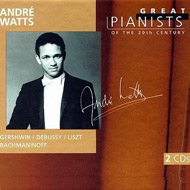
- Released by Philips 2-cd-set
- Duration: unknown
- Recording date: unknown
- Weiser, Bernhardt (piano solo) 'Variations on a theme by Chopin, op. 22. Variations on a
theme by Corelli, op. 42'
- Released 195? by M-G-M LP E 3250
- Wild, Earl (piano-solo) 'Earl Wild plays Rachmaninov'
Annette and Jeffrey Chesky wrote for the slipcase:More well known (than the 'Variations on a theme of Chopin') is the 'Variations on a theme of Corelli' Rachmaninov composed the work during the summer of 1931, a time of some despair for him. On January 15th of that year, his name appeared in the New York Times as a signatory to a letter that was critical of the current government in Russia. Tweo months laterin a Moscow review of a performance of his composition 'The Bells', he was referred to as a 'violent enemy of Soviet Russia'. This initiated a boycott of (the study and performance of) his music in Russia. Even though Rachmaninov said he was proud to be the object of such wrath, it must have hurt him deeply. Nevertheless, he commenced composing the 'Corelli' variations at the end of May, while in Clairefontaine, France. Although he complained that he did not have the time to compose and writing was harder for him now than when he was younger, he quickly completed it by the end of June. He then began to revise his second piano sonata.
It may have been Fritz Kreisler, to whom the 'Variations on a theme of Corelli is dedicated, who made Rachmaninov aware of Corelli's theme. (In 1928, they had recorded violin and piano works of Beethoven, Grieg, and Schubert.) Although the theme was used by the Italian composer and violinist Arcangelo Corelli (1653-1713) in the twelfth violin sonata (opus 5), the tune was not original with Corelli, but is an old Portuguese melody called La Folia. (Other composers besides Rachmaninov, such as C.P.E. Bach in his Twelve Variations auf die Folie d'Espagne, also utilized this theme.)
Rachmaninov's 'Corelli' variations can be grouped into contrasting sections. After the first thirteen variations (which are all in the key of D minor), there is an 'intermezzo', which is followed by two variations in the very alien key of D-flat major. For the last five variations and coda, Rachmaninov returns to to D minor. This work seems preparatory for his 'Rhapsody on a Theme of Paganini', which he composed three years later. Many of the variations (such as number 10) foreshadow the later work.
Rachmaninov gave the public premiere of 'Variations on a Theme of Corelli' on October 12, 1931, in Montreal. Based upon his remarks to his friend Nikolai Medtner (to whom Rachmaninov had dedicated his last piano concerto), Rachmaninov did not seem to enjoy playing this work. (He once said that playing his own music was boring.) Rachmaninov stated that whenever there was more coughing in the audience, he would skip the next variation! In one recital, he played only ten of the twenty variations, though in New York he performed eighteen. Moreover, for some curious reason, as in his earlier set of variations, Rachmaninov allows the performer the option of omitting three (numbers 11, 12, and 19). However, in both sets (also the Variations on a Theme of Chopin) of variations Mr. Wild properly plays them all!- Released 1991 by Chesky Records compact disc CD 58
- Recording date: 12/14 May 1991 in Fernleaf Abbey
- Duration: 17'40"
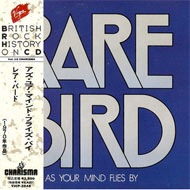
Flight including As your mind flies by |
Rare Bird - Sympathy (1970) - (9) As Your Mind Flies By
First appears at 0:37
- Rare Bird: Steve Gould (lead vocals, bass, rhythm guitar), David Kaffinetti (pianos, assorted keyboards), Graham Field (organ, assorted keyboards), Mark Ashton (drums, backing vocals) 'As Your Mind Flies By'
- Released 1970 by ABC/Dunhill Records vinyl order number 716, Charisma vinyl order number CAS 1011, Philips vinyl order number 6369 904. Re-released 1990 by Virgin VJCP compact disc, 2007 Esoteric recordings remaster compact disc ECLEC2002, 1999 by Phantom Records, 1997 by Red Fox Records
- Duration: 19'39"
- Recording date: 1970 in IBC Recording Studios, London, England
 Yes it is the Folía theme indeed especially the reference in the opening and the end with the quote of Alessandro Scarlatti on the harpsichord if I am not mistaken, but the rest is based on new fresh ideas. I guess also the litteral meaning of La Folía maddness with the repeated block chords. Very impressive and nice indeed with a prominent role for the oboes..
Karl Aage Rasmussen wrote in an e-mail April 04, 2016:
I shall of course happily contribute the info about Follia, follia
Presently I work as composer-in-residence for the well-known Danish period ensemble Concerto Copenhagen. When the great Italian oboist Alfredo Bernardini wanted to organize a concert centered around La folia, he asked me to write a short piece for this occasion and I immediately accepted. The endless number of variations on this 500 years old melody is a virtual relay race through history, literally "from time to time", and it was fascinating to imagine a tiny place for oneself in this line.
The instrumentation was more or less given from other pieces on the program. I wrote the music during the late summer of 2015.
- Concerto Copenhagen conducted by Alfredo Bernardini
- As part of the 2016 tour. it will be performed at the Musica Antigua Festival in Brugge Belgium August 12, 2016
- Recording date 2 November 2015 in Garnisons Kirche, Copenhagen, Denmark: by the Danish Radio broadcasting
- Duration: 8'00"
- For a live concert of Concerto Copenhagen including the composition Follia, follia http://www.dr.dk/p2/p2-koncerten/p2-koncerten-2015-12-09/ around 01'18'30"
- Visit the website of the composer at http://www.karlaagerasmussen.com/
The pianist Walter Ponce performed the world premiere of Piano Sonata No. 8 Il Trionfo della Folia at UCLA's Schoenberg Hall on Wednesday, November 5, 1997 at 8 PM.
Paul Reale wrote about Il Trionfo della Folia in November 1997:
"Il Trionfo della Folia" owes everything but its structure to the past.
I was working on Piano Sonata No. 8 when I first met Walter Ponce, and he expressed considerable interest in the work. At that
time I was not completely happy with the piece, but with Ponce's encouragement I
got it hammered out as the kind of virtuoso vehicle that I had imagined it could be.
Since the piece uses fragments at first, then complete phrases of the famous "Folia"
theme and since the other materials trade on the gestures, if not real quotations
from standard repertoire, I was justifiably concerned that the whole thing would
come off merely as a bombastic rehash.
The real key to the piece is the integration of at least six kinds of musical complexes,
all of which use intervals in varying orders from the "Folia" theme. Not until those
ideas are fully fleshed out does "La Folia" emerge with its concomitant harmony
and familiar bass. The real "trionfo" is that this familiar stuff becomes reborn in the
integration of its variants. The piece is cast in a single movement to emphasize the
continually developing and plastic nature of the musical materials.
- Ponce, Walter (piano)
- Worldpremiere not yet released in 1997
- Duration: 13'15"
- Recording date: November 5, 1997 at 8 PM
- The Orchestra dell´Angelicum di Milano, G. Tassinari violin 'Giuliani Violin Serenade'
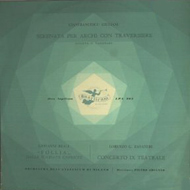
- Title: La Follia
- Released by Disco Angelicum lp LPA 962 (Italian pressing, edition mono)
- Duration: 8'20"
- Recording date unknown
- Sonatori de la Gioiosa Marca (Fava and Falcone violin, Vestidello cello,
Rado archlute and guitar, Rosato harpsichord) 'Follie all'italiana, sonatori de la Gioiosa Marca'
Sonatori de la Gioiosa Marca at You Tube in a live performance
Duration: 8'13" direct link to YouTube
© 2012 by Sonatori de la Gioiosa MarcasSonatori de la Gioiosa Marca at You Tube
Duration: 7'48" direct link to YouTube
© 2009 by Sonatori de la Gioiosa Marcas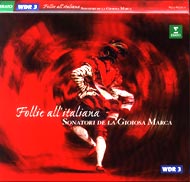
- Title: Folia from Suonate e Capricci op. I, Venezia 1709
- Released 2001 Erato Disques, Paris, France compact disc 8573 85775-2
- Coproduction Erato and Westdeutscher Rundfunk Köln
- Duration: 7'27"
- Recording date: June 11-14, 2000 Chiesa di S. Vigilio, Col San Martino Italy
- Virtuosi di Roma (violins: Luigi Ferro, Arrigo Pelliccia, Armando Gramegna, Alberto Poltronieri, Guido Mozzato, Remy Principe, Edmond Malanotte.
violas: Renzo Sabatini, Vittorio Fael. cellos: Massimo Anfiteatroff, Benedetto Mazzacurati.
bass: Salvatore Pitziant. harpsichord: Ornella Puliti Santoliquido. oboe: Renato Zanfini) director Renato Fasano.
'Virtuosi di Roma, Reali, Marcello, Albinoni, Vinci, Porpora'
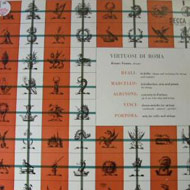
For the recording was written:
Born in Venice in the second half of the 17th century, Giovanni Reali was a little-known Italian violinist and composer. He is said to have been 'maestro di cappella' in Guastalla in 1725. Among his works are sonatas and caprices for 2 violins and basso continuo, which were published as Opus 1 in Venicein 1709. This volume also contained the present Theme and Variations on 'La Follia', which were dedicated to Arcangelo Corelli, the author of a set of variations on the same theme. Compared with those of other composers who have been inspired by this famous theme, Reali's Variations lack nothing in wealth of invention, color or appeal.
- Title: La follia, theme and variations for strings and cembalo (1709)
- Released 1957 by Decca gold label series LP DL 9731
- Duration: 6'49"
- Recording date not mentioned in the documentation
Gérard Rebours wrote in July 2002 about his Folias Nuevas:
My own 'Folias Nuevas' for baroque guitar has not been recorded yet. I should do it! It is one page only and it's like a 'prelude on the Folia' in fact.
- Rebours, Gérard
- Title: Folias Nuevas
- Not recorded yet
- Sheet music 1 page, published by Rebours, Gerard (with fingersetting) in pdf-format at his website http://g.rebours.free.fr/1P/FoliasNuevas.pdf
- Duration: c.1'00"
- More about this composer/guitarplayer who also published three articles about the Folia in the French magazine 'Les Cahiers de la Guitare' is available at his website: http://www.GerardRebours.com
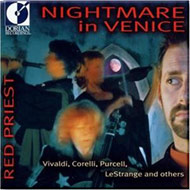
Fantasy on Corelli's La Folia (2001) |
But after 4 minutes the unexpected occurs. All of a sudden the scene shifts towards a Middle East desert and the recorder is expressing the vibrating heat with its slow half-tone shiftings, while the harpsichord is imitating the canun. You cannot listen to the rest of the Folia with the same ears as before and with good reason. The harpsichord as basso continuo imitates tripling mice, weird glissandos of the cello invade, an imitation of a variation by Salieri where the harpsichord-solo is trying to stretch into an symphonic orchestra can't be denied and a groovy bass attacks an uneven 20th century Balkan-meter. No wonder this group is called the Cirque du Soleil of baroque performance ensembles.
I guess Red Priest is not the most obedient student of the class, but such musical expertise combined with humor will put a smile on your face. Piers Adams wrote in September 2001 for the slipcase:
La Folia - literally a folly, or even, madness - began life as a 16-measure ground (melody and bass), composed sometime in the 16th century in Portugal. Whoever wrote it should have posthumous claim to some substantial, overdue royalty payments, as the tune was to become one of the most eduring and widely used of all grounds, subjected to expansion and variation by composers from Vivaldi to Rachmaninov and beyond. One of the most famous sets of Folia variations was written by the celebrated Italian violinist Arcangelo Corelli sometime around the year 1700, as the conclusion to his Opus 5 set of violin sonatas, and later arranged for recorder and continuo. It is this latter version that we have used as a framework for ours, adding a second part for the violin and freely infiltrating our own material throughout. Whilst the resulting musical madness may not fit the currently accepted boundaries of 'authenticity' we hope that it is taken in the truly Baroque spirit with which it - and indeed the whole album - is intended...
Frank T. Nakashima wrote for Whole Note Magazine (Toronto) in December 2002:And do we really need another recording of Corelli’s La Folia? No? Wrong answer. Red Priest’s own Fantasy based on this famous piece is outrageous, raucous, and radical, but still within the realm of historical possibility.
- Red Priest: Piers Adams (recorders), Julia Bishop (Baroque violin), Angela East (cello), Howard Beach (harpsichord)
- Released 2002 by Dorian Recordings compact disc DOR-90305
- Duration: c.12'32"
- Recording date: May 2001 in the Françoys-Bernier concert hall at the Domaine Forget in saint-Irénée, Québec, Canada
- Red Priest: Piers Adams (recorders), Julia Bishop (Baroque violin), Angela East (cello), Howard Beach (harpsichord)
- Broadcasted live a concert by SWR2, German radio during the Schwetzinger Festspielen
- Duration: 10'32"
- Recording date: June 19, 2007 in the Rokokotheater Schloss Schwetzingen
That he was befriended with Salieri who published his massive Folia-variations in 1815 may have been the inspiration of Reicha's folia-compositions.
|
Duration: 2'38", 05 kB. |
|
Sheet music in pdf-format |
- Ippolitov, Erakko
Folie d'Espagne
Duration: 2'37" direct link to YouTube
© 2014 by Erakko Ippolitov- Title: Folie d'Espagne Op. 97 No. 33
- Released March 2014 on YouTube by Erakko Ippolitov
- Duration: 2'37"
- Recording date: March 28, 2014 at Niigata, Japan
- Reicha, Anton
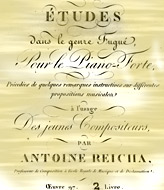 Vincent Decleire, who detected the étude wrote as reaction to the midi-file in September 2006:
I think that the tempo may be little slower but not so much (redaction: instead of the 82 and the suggestion to drop the tempo to adagio) . In the opus 97 of Reicha, there is no adagio but lento. Others studies are indicated : andante maestoso, or poco andante. So Reicha indicates precisely what he wants.
Some of the others studies are Arias and they are notated as sarabands but not in 3/4 but in 3/2. In this case, the "brevis nota" of the first mesure is also a quaver or a semiquaver, so shorter in comparison. So Reicha knew the difference...
If you want to play slower, you need a very better quality of sound and a intense "sentimental" (Reicha knows Kant !) play. I had not yet the occasion of playing this piece on a fortepiano to hear how it can sound and to hear the resonance of the full accords, which would influence the tempo.- Title: Folie d'espagne
- In: Etudes dans le genre fugue pour le Piano-Forte précedées de quelques
remarques instructives sur differentes propositions musicales á l'usage Des jeunes Compositeurs
par Antoine Reicha, Professeur de Composition á l'ecole Royale de Musique et de
Declamation, Oeuvre 97, 2e livre published by Melles Erard, Rue
du Mail, no. 13, Paris, France
- Publisher's No. 892, pages 152 and 153
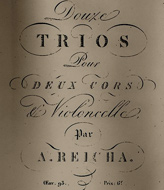
-
These trios are originally arranged for two horns and a cello, probably intented for the horn-virtuosi the brothers Boeck.
Louis François Dauprat (1781-1868), a hornist who was closely related to Reicha, made an arrangement for three horns.
With the consent of Reicha he substituted the Folie d'espagne (no. 4) by an original composition of Dauprat. Most likely because
all voices of the music were not very suitable for the (natur)horn.
- Title: Folie d'espagne
- Published by Pleyel in Paris 1825
- Publisher's number 1378/79
- Rijksarchief Gelderland in Arnhem (RAGld) (Archives of the Province (region) of Gelderland in the Netherlands)
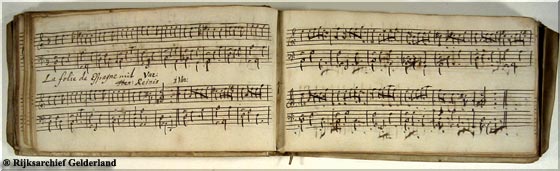
The booklet with sheet music was part of the archives of the family Bosch van (von) Rosenthal and was intended as a guide to practice for B. Kloeckhoff (1680-1764) dated back to 1695. For this Folia the name Hen. Reinis was mentioned next to the title as if he has made the entry in the booklet. His name and handwriting appear several times in the booklet as the signature of some pieces. Notice that a bit of the tune at the backside of the paper seems to shine through due to the agressive chemical reaction of the ink on the paper over the ages.
The booklet contains two other anonymous versions of the Folia which are classified under anonymous for keyboard (manuscript Arnhem, 1 and 2). One of these manuscripts has identical variations. The variation of Reinis 2, 6 and 9 match the variations of inventory number 956 8, 9 and 5 respectively.- Manuscript 0724 Archives of the family Bosch van (von) Rosenthal and relatives
- The years 1418, 1539, 1584, 1600-1953
- Inventory number 960
- Pages: 16 pages
- Rijksarchief Gelderland is vested in the city of Arnhem The Netherlands and can be contacted at http://www.geldersarchief.nl
- Kostujak, Wolfgang (harpsichord) 'Nordrheinische Musik des 17. Jahrhunderts'
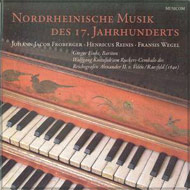 The last variation of the recording was written/improvised by Wolfgang Kostujak himself and was no part of the manuscript.
Wolfgang Kostujak wrote for the slipcase (in a translation by Nathalie Scheeck):
Duration: 1'07", 1054 kB. (128kB/s, 44100Hz)
Last two variations and Kostujaks variation
© Wolfgang Kostujak 2008, used with permissionEven during the 15th century, 'Follias' were the ecstatic peaks of traditional fertility ceremonies in the cultural area found to the South-West of the Pyrenees. A continuing repetition of the same harmonic formula was supposed to conjure up spirits and put the dancers in a trance-like state. This effect corresponds to the meaning of the word 'Folia' as a generic term for 'madness', or 'craziness', but also for 'infatuation' in Portuguese- and Spanish-speaking areas.
The last, fifteenth variation on the 'FOLIE D'ESPAGNE' BY HENRICH REINIS is, in this interpretation, a more or less spontaneous – swept along – improvising continuation of the theme by the musician.
Based on the knowledge that performance practice of the 17th century was far more linked to the idea of a musical improvisation in many respects than to the playing of pre-fabricated notes, some middle voices for the dance movements in the suites in the course of the 'Follia' were written by the musician according to the rules of basso continuo and compositional theory in the 17th century.- Source: Manuscript 0724 Archives of the family Bosch van (von) Rosenthal and relatives
- Title: 'La folie de Espagne mit Var:'
- Released 2008 by Musicom compact disc CD 030216
- Duration: 5'52"
- Recording date: September 27 till October 1, 2007 in Schloss Ringenberg, Germany
- Harpsichord built by Joannes Ruckers d. J. (Antwerpen 1640) and modificated several times, stops: II, 8', 8', 4', [4'] owned by the 'Alexander-und-Alexandrine-von-Velen-Stiftung.
- More about Wolfgang Kostujak at his homepage http://www.wolfgangkostujak.de/editionen.htm where the complete Folies d'Espagne in modern sheet music in pdf-format is to be found (filed under : 1. Auswahl aus den musikalischen Editionen: Kloeckhoff-Manuskripte: diverse Variationswerke)
- Luijmes, Dirk (harpsichord) 'La Folie d'Espagne, 17th century keyboard music from Gelderland'
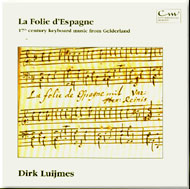
Duration: 1'30", 1433 kB. (128kB/s, 44100Hz)
Variation 9, 10, 12 and 13
© Dirk Luijmes 2003, used with permission- Source: Manuscript 0724 Archives of the family Bosch van (von) Rosenthal and relatives
- Title: La folij de Espagne (this is not the original title in the manuscript because La folij de Espagne is another piece in the manuscript. The titles and pieces are clearly mixed up)
- Released 2003 by C&M Contrapunctus Musicus compact disc VC 2509
- Duration: 5'51"
- Recording date: not indicated at all but it should be 2003, location not indicated either
- Harpsichord built by Gerard Kras (1980) after Andreas Ruckers
- cd financially supported by the Bosch van Rosenthal Stichting (foundation)
- Dirk Luijmes wrote about the manuscript in Tijdschrift Oude Muziek
- More about Dirk Luijmes at his homepage http://www.dirkluijmes.nl.nu/
|
Duration: 5'56", 20 kB. |
|
7 page in pdf-format, 121 kB |
| Manuscript from the archive Bosch van Rosenthal with the name of Hen. Reinis |
© Rijksarchief Gelderland, used with permission |
|---|---|
 |
|
- Armanni, Mara (violoncello)
- First performance October 15, 1985 at the Festival di Imperia
A 6-musician ensemble defining a new music genre by combining ancient, baroque, folk, middle-eastern and ambient, which they call progressive folk.
- Rêverie
'2004'
- Title: La Follia Part 1 La Danza, La Follia Part 2 Sonetto
- Released 2008 by Rêverie compact disc
- Duration:Part 1 3'10" Part 2 2'11"
- Recording date: unknown
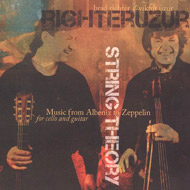
- Richter, Brad (guitar) and Uzur, Viktor (cello) 'String Theory: Music from Albéniz to Zeppelin'
- Title: La Folia (for ensemble)
- Released 2010 by Blue Griffin Recording compact disc 205
- Duration: 9'44"
- Recording date:June 11-13, 2009 in Brad’s studio in Tuczon, Arizona, USA
- Brad Richter plays a Q guitar by Trevor Semple
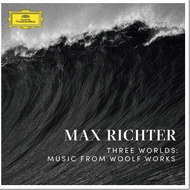
In an interview for the French radio station Inter in the program Boomerang the 26th of January Max Richter explains that the melody was taken from the '16th Century melody of the Folía' and even hums the melody line. Source https://www.franceinter.fr/emissions/boomerang/boomerang-26-janvier-2017
The music is clearly based on the later Folía (after 1672).
- Deutsches Filmorchester Babelsberg, conducted by Robert Ziegler 'Three worlds, music from woolf works'
- Title: Modular Astronomy
- Released 2017 by Deutsche Grammophon order number 0289 479 7158 0
- Duration: 3'14"
- Recording date and place unknown
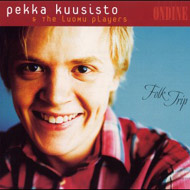
The Lampaanpolska is found in the notebook (nuoti-kiria) of this 18th century Ostrobothnian folk fiddler
- Kuusisto, Pekka (violin solo) 'Folk Trip'
- Title: Polska III Lampaanbolska (instead of the more commonly used 'Lampaanpolska') dated 18th Century
- Released 2002 by Ondine compact disc ODE 1018-2
- Duration: 2'00"
- Recording date: August 27-30, 2002 at Granite Hall, Supmentinda, Finland
- Rivoal, Yvon
- Title: La Folia
- Published by Editions Henry Lemoine LEMOI02353
- Size 20x21 cm
- Published for the first time by Rivoal July 15, 1996
This concierto for violin and orchestra consists of three parts: Prelude, Sicilienne and Rondino. Right from the start of the the Sicilienne (and in this movement only) the first 8 bars of the Folia-theme are exposed several times, although the theme of Rodirigo is extended with 4 more bars (ending in the dominanth septiem). The theme is twisted in several ways as a reflection of an image in the water.
- Castilla & León Symphony Orchestra conducted by Max Bragado-Darman 'Concierto in Modo Galante / Concierto de Estío'
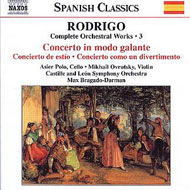
- Released 2003 by Naxos compact disc 8555840
- Duration: 9'20"
- Recording date: unknown
- Ferras, Christian (violin), Barbizet, Pierre (piano) 'Christian Ferras'
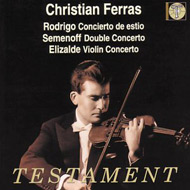
- Released 2003 by Testament compact disc SBT1307
- Duration: unknown
- Recording date: unknown
- London Symphony Orchestra conducted by Agustin Leon Ara 'The Rodrigo Edition'
- Released 1992 by EMI Classics (Angel Records) compact disc (4 cd-box) 67435-2
- Duration: 7'55"
- Recording date: unknown
Written for viola, cello, double bass, 2 violins and harpsichord
Variations et Les Folies d'Espagne (2013-2014) |
Kristian Oma Rønnes wrote about this piece January 6th, 2014:
My idea with the piece was that the La Folia theme should gradually appear, not be obviously played at once as the Folias often tend to do. The piece is also written in a-minor, not the normal d-minor, which I think suits it better. (despite that the midi file performs it in a-flat minor, for making it sound as the Baroque tuning of 415)
The piece starts in the wrong time signature (2/4) and without the La Folia chord progression. The correct chord progression appears first at bar 18, but still in the wrong time signature (2/4). The first theme goes threw several variations and almost unnoticeable get it self into the correct time signature of the La Folia (3/4) in bar 66. The full La Folia theme can now finally appear since the correct time signature and chord progression have been presented. Finally on variation no. 5 as a result of the previous development of the earlier variations the main theme appears in a proud fortissimo.
The piece ends with an quiet extreme contrapuntal Coda later named: "Chaos" in bar 267. Here several of the earlier variations meet and blends them selves in with some of the newer variations, where all the parts should be played as individualistic solo parts; non should be hidden away, all the parts are equally important!
- Kristian Oma Rønnes (midi- and sound devices, sheet music)
- Published January 2014 by Kristian Oma Rønnes at YouTube
- Duration: 7'15"
- Recording date: January 2014 in Oslo, Norway
- More about the composer Kristian Oma Rønnes at his website http://www.kristianomaronnes.com/
|
Duration: 0,43", 04 kB. |
|
Duration: 2,16", 28 kB. |
|
Duration: 2,05", 08 kB. |
|
Duration: 2,19", 24 kB. |
I began working in December 2001 on a
set of variations on the theme known as 'La Follia'.
La Follia was an excellent choice, because it is for me an example of a
truly perfect theme. It's aural appeal alone makes me want to listen to
it over and over, making it a ready candidate for variations. It's 16
bars are the paragon of balance; 8 bars take you from tonic to dominant,
and another 8 bars take you back. It is capable of being both very
simple and very complex. It's no wonder that literally hundreds of
variations on La Follia have been written over the last 4 centuries.
My variations (completed May 26, 2002) are based on Jean-Baptiste
Lully's 'Les folies d'Espagne' of 1672 -- one of the earliest examples.
The first movement of my sonata simply presents the theme on which the
following movements are based, and is basically identical to Lully's
opening theme, except that I removed all ornamentation in my version.
The meter of almost all Follia variations is in 3. The first thing I
wanted to try was a variation in 2/4 time, which is what I did in the
second movement. Also, most Follia variations simply repeat the 'Follia
chord-progression' over and over. I had to get away from that as well in
order to accomplish the key transitions necessary in Sonata form. The
second movement opens with the familiar 16-bar chord progression, then,
during the development, departs on a transition towards the dominant A
minor, eventually returning to D minor for the recapitulation.
The third movement opens with a variation in which La Follia is reduced
down to the chord progression itself. The central section is
essentially a diminution of the theme, with a transition back to a recap
of the beginning.
The fourth movement is in the form of a Rondo, which allowed me 4
variations in ABACDCABA format. The 2 solo violins alternate throughout
the movement, giving both an equal opportunity to play the theme.
This set of La Follia variations, written in the Baroque style, is a
testament to the La Follia theme itself. No other theme in the history
of music has been so readily and widely adaptable to variation.
- Rothschild II, Jonathan David
- Published 2002 by The Frobozz Magic Sheet Music Co. Publisher number EF-R15A
- Duration: Tema Larghetto 0'43", Presto 2'16", Largo-Larghetto-Largo 2'05", Allegro 2'19"
- Sheet music in pdf format (you need
 to read or print the sheet music),
13 pages in total and in 4 parts, 3 pages each violin one
and violin two, 2 pages violoncello, 4 pages harpsichord. © J.D. Rothschild II, used with permission
to read or print the sheet music),
13 pages in total and in 4 parts, 3 pages each violin one
and violin two, 2 pages violoncello, 4 pages harpsichord. © J.D. Rothschild II, used with permission
 Tomas Vitek who detected this Folía, wrote in an e-mail March 13, 2014:
I've come across another potential La Folia entry for your website during my research. The piece is currently not featured on your list.
Below is the information that I found; it does not give any further description of the music or a score sample since it only exists in manuscript, but I presume that it shouldn't be too difficult to get additional information from the Budapest Music Center (BMC) or the composer directly
- Rózsa, Pál
- Title: "La Folia" Variations for Brass Op. 149 (for 16 performers)
- Not yet published (manuscript finished 1989 (?) because the premiere of the piece was in 1989)
- Instrumentation: 3 cor., 5 tr., 4 trb., 2 tuba - perc. (2 players)
- Duration: ca. 10'00"
- Source: Budapest Music Center website http://info.bmc.hu/index.php?node=artists&type=C&search=R%C3%B3zsa+P%C3%A1l++++++++++++++++&search_tol=&search_ig=&valaszt=nev
- Title: "La Folia" Variations for Brass Op. 149 (for 16 performers)

Rubato Appassionato: Antonia Tejada (recorder), Eyal Street (baroque bassoon), Sasha Agranov (violoncello).
Duration: 15'31" direct link to YouTube
|
We found it in the Biblioteca de Cataluña in Barcelona.
The manuscript, titled "Partes de Folias", has a theme and then 13 variations. Some of these variations are very closely influenced (and even copied) by other published folias from the time (like Corelli's, for example). We added then another 16 variations which fit the character of this folia very well.
I can't give an accurate date for this folia, but it's definitely 18th century and as I said must be after Corelli's publication since there is at least one very clear quotation
- Rubato Appassionato 'El Carnaval de Madrid'
- Released 2011 by AcoustiCDelicatessen CD 001 compact disc ACD 001
- Duration: 17'01"
- Recording date: November 2009 in at the church of Saint Basil, Seville, Spain
- More about Rubato Appassionato at their website http://www.rubatoappassionato.com/

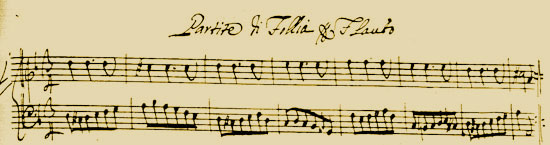
| Opening of Partite De Follia Flauto | MS de Venezia, Biblioteca Palatina, Parma |
|---|---|
 |
|
The Folia theme was a popular tune in Europe between the 16th and 18th centuries. There are two different types of Folias: The Early Folia (earliest described in Salinas's De musica libri septem, 1577) and the Late Folia (starting from the 1670's). The differences between the early and the late folias are more evident in the melodic and rhythmic patterns than in the harmony. The late folia is attributed to Jean-Baptiste Lully (1632-1687). It received popularity all over Europe: In France it was called foli(e) d'Espagne, in England Farinell(i)'s Ground. Pablo Miguel y Yrol (Reglas y advertencias generales, 1754) calls the earlier type folias españolas and the later type folias italianas. Folias usually have many variations. The Partite de Follia of the MS in Venice belongs to the late Folia.
Eyal Streett wrote about this composition:As you can see the two most interesting thing about this particular folia are:
1. the elaborate bass line in the theme.
2. the second half of the theme which is harmonically unique
.
In addition to the given variations in the manuscript, we have added a number of variations ourselves. As you can see, the original manuscript is for recorder and basso continuo. We realize the b.c.
part with both a cello and a bassoon. This means we have to add another part so actually our version of this follia is for three parts not two.
- Rubato Appassionato 'Le Temple Du Goût : 18th Century Music From Italy And France'
- Released 2008 by MA Recordings compact disc M075A (JP)
- Duration: 13'56"
- Recording date: October 2006 in Capella de la Mare de Déu de l'Esperança, Barcelona, Spain
- More about Rubato Appassionato at their website http://www.rubatoappassionato.com/
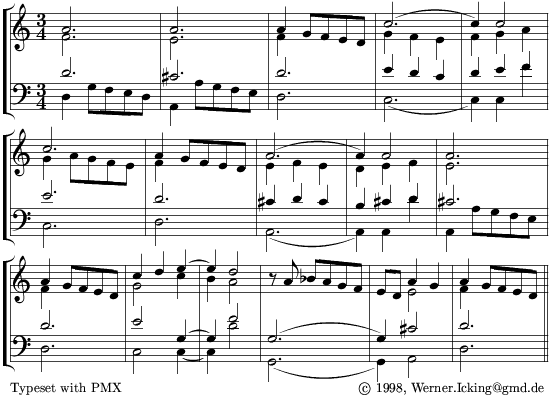
published in 'Luz y norte musical', Madrid 1677, Ruiz de Ribayaz was a priest and vihuela-player as far as i know.
|
Duration: 1'35", 03 kB. |
| Theme of Folías | by Hudson Vol I, p. 95 |
|---|---|
 |
|
- ASNI (harp) with Laurie Randolph (baroque guitar) '700 Years of Pop'
 Astrid Nielsch (ASNI) wrote about the Folia in an e-mail:
I've always been intrigued by the folia myself, when I was a teenager and living in Brazil there was a popular pop song (I forget by which band) that had the lines "quando a folia passa,. something something multidao" (when the folia passes by, it entices the crowds) and I've always wanted to know what that was about, so thanks for finally shedding light into this 20-year-old puzzle! :-)
- Released 2003 by Keep Cool! (Germany) compact disc LC 02783
- Duration: 1'57"
- Recording date: September 2002 at Martin Luther Kirche, Berlin, Germany
- The homepage of Astrid Nielsch with lots of music can be foud at http://asni.net/indexengl.html
- ASNI (harp) with Pepe Becker (soprano), Robin Ward (triple harp) 'Love, Lament & Lullaby'
- Title: Lucas Ruiz de Ribayaz' Folias and Tarquinio Merula's Canzonetta spirituale sopra la nanna
- Released 2003 by ANSI compact disc without order number
- Duration: c. 1'57" (only the Ruiz de Ribayaz)
- Recording date: April 8, 2003 live recording from a recital at St. Andrew's on the Terrace Wellington, New Zealand
- Constantinople 'Terra Nostra'

This is an arrangement for viola da gambas, guitars and violins of the folías by Sanz (originally for guitar, 1674) and Ruiz de Ribayaz (originally for harp, 1677)- Title: Folías
- Released 2007 by Atma Classique ACD22567
- Duration: 2'48"
- Recording date: November 21-23, 2006 in Eglise Saint-François de Sales, Laval, Quebec, Canada
- Duo Arpeado ( Cristina Azuma, Brazilian guitarist (Baroque guitar) and Fran¸oise Johannel, French harpist (arpa de dos ordenes)
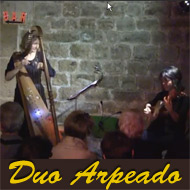
This is an arrangement for Baroque guitar and harp of the folías by Sanz (originally for guitar, 1674), Guerau (originally for guitar) and Ruiz de Ribayaz (originally for harp, 1677)Duo Arpeado in a live performance in Paris 2011
Duration: 2'48" direct link to YouTube
© 2011 by Duo Arpeado- Title: Folias - Guerau / Ribayaz
- Released 2012 at YouTube by
- Duration: 2'48" The variations by Ribayaz 0'45" - 1'22" (two variations) and 1'58" - end (one variation)
- Recording date: November 2011 during the Festival Marin Marais in Paris, France
- Eilander, Maxine (Spanish and Italian harps, Stephen Stubbs: baroque guitar) 'Teatro Lirico'
These Folia-variations are an enumeration of two pieces: an anonymous Spanish manuscript for harp and the manuscript by Lucas Ruiz de Ribayaz with a nice intro.- Title: Folia Variations (for harp and baroque guitar, 2004)
- Released February 2006 by ECM New Series 1893 4763101
- Duration: 3'32"
- Recording date; February 2004 in Propstei St. Gerold
- See also the page Recommended Folia-recordings
- Garcia Banegas, Cristina (organ) 'De la musique des conquistadores au livre d'orgue des indiens Chiquitos'
- Released 1998 by Discographique lorrain K.617 compact disc set of 3 discs K617093/2 with the support of the French Ambassy
- Duration: 0'58"
- Recording date: May 1-3, 1998 organ of Santa Clara in Sucre, Bolivia
- The Harp Consort conducted by Andrew Lawrence-King 'Spanish Dances - Ribayaz: Luz y Norte'
In the slipcase is written:An arrangement of Ribayaz Folia by the Harp Consort
Duration: 4'36" direct link to YouTube
© 1996 by Deutsche Hamonia Mundi
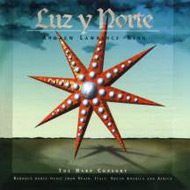
The fiery passions of the 16th century Portuguese folias were still smouldering in the folias italianas style to be found in Luz y Norte, but the dance became a vehicle for the exhibition of technical virtuosity in the French Folies d'Espagne
- Released January 16, 1996 by Deutsche Harmonia Mundi compact disc 77340
- Duration: 4'36"
- Recording date: September 1994 at Valkkoog
- Zabaleta, Nicanor 'Hispaniae Musica, Spanische Harfenmusik des 16. und 17. Jahrhunderts' as part of a series: IV. Forschungsbereich Hochrenaissance (16. Jh.), VII. Forschungsbereich Westeuropa zwischen Barock und Rokoko (1650-1800)
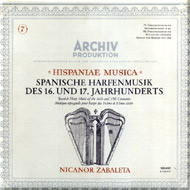 Nicanor Zabaleta wrote for the slipcase:
Lucas Ruiz de Ribayas (born in a small town near Burgos about the middle of the 17th century) published 25 pieces conceived specifically for the harp in his work Luz y Norte músical para caminar por las cifras de la Guitarra y Arpa (Madrid, 1677). Bacas, Folias, Paradetas, Pabanas and Hachas are names of ancient Spanish dances which today have completely disappeared.
- Released 1968 ? (year not indicated at all) by Archiv Produktion LP 198 458
- From the manuscript Luz y norte músical para caminar por las cifras de la Guitarra y Arpa, Madrid 1677. All transcriptions by Nicanor Zabaleta
- Recording date: September 26-30, 1968 in Notre Dame de Liban, Paris
- Duration: 1'33"
- Harp built by Horngacher, Starnberg 1968