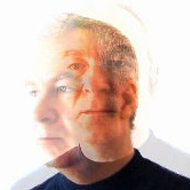
Diego Dall'Osto wrote about his composition in an e-mail May 22, 2013:
It happend that the choreographer Nicolo Fonte, told me about his project to create a choreography with some, intially generic, baroque inspiration.
So I suggested to use the Follia theme, as one of the most emblematic of the baroque era. A theme that I love particularly anyway. In a second meeting we had the idea of integrating Vivaldi's Folia in a revisited, rearraganged version. Like chinese boxes, a new series of variations on La Follia, fitting a version (mine) of another version (Vivaldi's).
- Diego Dall'Osto and the orchestra of the Goteborg Opera House
- Performance date 2004 at Goteborg Opera House, Sweden
- Duration: 42'30" (including c.10' the arrangement of Vivaldi's Folia)
- Some fragments of the piece you can find at http://www.dallosto.com/en/audiovideo.php including a YouTube-file with a new arrangement of a Folia based upon Vivaldi's Op. 1 no. 12
- More about this composer at his website http://www.dallosto.com/en/
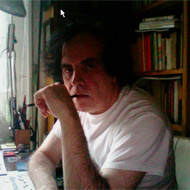
- Luisa Mauro (mezzozsoprano), Rokk Jakaj (violin), Mario Torni (violin), Gustavo Fioravanti (viola), Alfredo Giarbella (cello),
Kim Sung-Hwa (pianoforte) conducted by Irlando Danieli
- Composed in 1999 copyright Irlando Danieli
- Duration: 9'00"
- Performance date: June 24, 2000 in Sala Verdi, Conservatorio Milan, Italy
- More about this composer at http://www.wickymusic.com/dettaglio_compositore.asp?IDcompositore=25&pagina_load=/dettaglio_compositore.asp
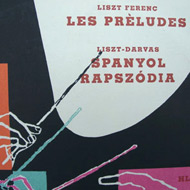

- Österreichische Nationalbibliothek, Wien
- Published in facsimile, János Darvas, Köln
- Year of Manuscript 1952-1960
- Recordings: -Qualiton-HLPM-1549 (1954) -Qualiton HLP 108 -Parliament-PLP-124 (1960) -Gloria-C-045-91165 -Westminster WST 14151 -Qualiton-SLPX-11341 (1967) -Qualiton-MK-11341 (1967) -Hispavox HUNS 660-02 (1974)
- More about this composer at http://www.darvas.de/gd
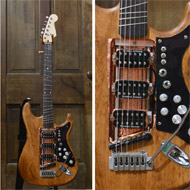
Michael Davis wrote about the composition:
This recording is provided simply for the purpose of demonstrating the instrument. The performer is not a professional, and many will say that this music is inappropriate. They are probably correct.
- Michael Davis
- Composed in 2018
- Duration: 4'11"
- Performance date: unknown
- More about this composition and the guitar used http://autolich.com/nextgenguitar.html
- Delucchi, Emanuele
- Published at the internet at http://imslp.org/wiki/La_Folìa,_Op.10_(Delucchi,_Emanuele)
- Copyright: Creative Commons Attribution Non-commercial 3.0
- Score: 11 pages
- Publisher's No. not mentioned
The Camerata Singers of Monterey County
|
- The Camerata Singers of Monterey County, artistic director John Coza
- Published at YouTube January 5, 2014
- Duration: 4'16"
- Recording date: May 2008 in the First United Methodist Curch, Pacific Grove, Canada.
- Roux, Didier Le and Bazin, Jean-Paul (mandolins)
'The Mandolin through the ages'- Released by Musical Heritage LP 1984
 |
Duration: 1'33", 06 kB. A transcription for midi of one of the 'variations' Sequenced by the composer 1997, © David Denniston |
This particular variation uses an oboe and several sounds which are approximately like a piano, so it works acceptably in midi format. I have tried several of the others but not with much success. Most of the variations use sounds which are nothing at all like the QuickTime instruments.
- Denniston wrote about his La Folia Mutations in November 1997:
My version is an entirely electronic composition (so there is no printed score) and is more-or-less a theme and variations, except that the variations move progressively farther from the original tune, eventually reaching a sound-universe unimaginable to a 17th-century musician, and containing melodic and harmonic fragments only distantly derived from the original. The whole piece is about 15 minutes long. Eventually there will be a choreographed version. It has been heard on several concerts on the West Coast of the U.S. and will appear on my CD next year sometime.
- Score: 1 manuscript 30.7 x 22.4 cm.
- Published c. 1825 by Duhan, Paris
- Published by Lemoine, Paris 21 p.
- printed version in RISM A/I, D 1674.
- Contents: (f. 1v:) 1.re Prelude, g, 3/4 -- (f. 1v:) 2.e Prelude, g, 3/4 -- (f. 2r:) Thêma, g, 3/4 -- (f. 2r:) 1.re Exercice, g, 3/4 -- (f. 2v:) 2.me Exercice, g, 3/4 -- (f. 3r:) 3.me Exercice, g, 3/4 -- (f. 3v:) 4.me Exercice, g, 3/4 -- (f. 4r:) 5.me Exercice, g, 3/4 -- (f. 4v:) 6.me Exercice, g, 3/4 -- (f. 5r:) 7.me Exercice, g, 3/4 -- (f. 5v:) 8.me Exercice, g, 3/4 -- (f. 6r:) 9.me Exercice, g, 3/4 -- (f. 6v:) 10.me Exercice, g, [3/4] -- (f. 7r:) 11.me Exercice, g, 3/4 -- (f. 7v:) 12.me Exercice, g, 3/4 -- (f. 8r:) 13 Exercice, g, 3/4 -- (f. 8v:) 14.me Exercice, g, 3/4 -- (f. 9r:) 15.me Exercice, g, 3/4 -- (f. 9v-10r:) 16.me Exercice, g, 3/4 -- (f. 10r:) 17.me Exercice, g, 3/4 -- (f. 10v:) 18.me Exercice, g, 3/4. (f. 11v:) 20.me Exercice, g, 3/4 -- (f. 12r:) 21.me Exercice, g, 3/4 -- (f. 12v:) 22.me Exercice, g, 3/4 -- (f. 13r:) 23.me Exercice, g, 3/4 -- (f. 13v-14r:) 24.me Exercice, g, 3/4.
- Stanford copy 1 (MUSCL): No. 1 in a vol. with binder's title: Musique de harpe `a mlle. Bovis. Fantaisie, Year: 1810-1819
- Desprez, Fernard
- Published 1963 by Maurer Editions, Bruxelles
- Score 8p. and 6 parts. 34 cm, percussion part optional
- Publisher No. PH 304
This composer for the 5- and 6 course guitar wrote approximity 200 compositions for guitar solo and for guitar with piano, brass or violins. The name of this composer is often confused with the composer C. Lintant (1758-1830) who also wrote music for the guitar. So the fictive name 'Doisy-Lintant' is sometimes referred to in literature (Eitner) to indicate Doisy.
- Drouet, Louis François
- Published 1821 by Hentz, Paris (flute solo) and 1823 (together with 'Air della molinara') by André, Offenbach (two flutes)
- S: Whist. 1821 (solo) and S: Whist. 1823; 1844 L: DK: A NI DHwn (2 flutes)
- Score: unknown
- Publisher's No. unknown
- Quakernaat, Peter editor of the sheet music for two flutes
- Published 1960 by Broekmans & van Poppel, Amsterdam, the Netherlands
- The other air is 'Air della molinara'
- Score: 2 parts, 31 cm
- Publisher's No. 342
- Drozdov, Anatolij
- Published in Six morveaux anciens: pour piano: d'apres les maitres de luth et de guitare des XVI et XVII siève; cles or in original Russian language: 'Sest' starinnych p'es: dija fortepiano: po ljutnevym i gitarnym materialam XVI i XVII vekov'
- Published 1940 by Gosudarstvennoe Muzykal'noe Izdatel'stvo, Moskva
- Total of 21 pages size 30 cm
- Publisher's No. M. 16583 G
- With an introduction in the Russian language
- Part of the collection of the Royal Library in Den Hague NMI12.2, collection Hugo van Dalen (Volume 71)
David Norton wrote in the classical guitar forum ( http://www.delcamp.us) 26 September 2009:
This is extremely reminiscent of the Ponce set, but many shades easier. As it was explained to me by Duarte himself some years ago, the word "simple" was added to the title at the insistence of the editor for marketing reasons. Duarte denied any concept of the piece being a "homage to Ponce" in any way, but in complete truth there's no chance that anyone who has played this set and who has heard the Ponce cycle cannot help but draw the conclusion that Ponce was a strong subliminal influence here, and the composer's protestations to the contrary be damned. The Duarte set runs about 5 minutes in length and is really worthy of concert performance.
David Norton wrote in the classical guitar forum ( http://www.classicalguitardelcamp.com/viewtopic.php?t=73908) 25 December 2012:John Duarte's "Simple Variations on Las Folias, op. 10". The word "simple" in the title was added at the insistence of Dr. Boris Perrot of the London Philharmonic Society of Guitarists (PSG). Duarte had written his "Impromptu in Eb, Op. 8" for the PSG, and Dr. Perrot shamefacedly had to tell Duarte that the key of Eb made it untenable for most of the PSG members to tackle. So Duarte came up with the Folias variations as an alternative, adding "simple" to the title so as to encourage the PSG members to give it a go.
 |
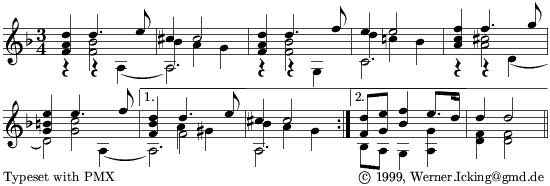
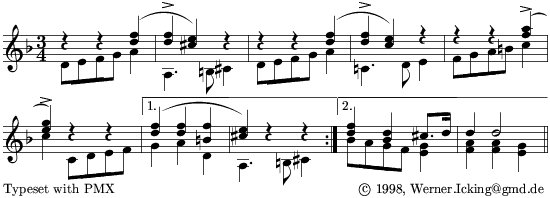
Duration: 1'15", 02 kB. Theme as indicated below in the sheet music and the first variation |
| Theme of 'Simple Variations on Las Folias' | Columbia Music, 1964 |
|---|---|
 |
|
| First variation of 'Simple Variations on Las Folias' | Columbia Music, 1964 |
|---|---|
 |
|
- Duarte, John W.
- Published by Columbia October 1951
- Publisher No. CO 152

- Ouzounoff, Alexandre (editor of the music)
- Title: Variations des Folies d'Espagne (Urtext) pour Basson solo, / PAR EM. DUCREUX Elève de Devienne . / PRIX 1f 80c / Chez CORBAUX, Md. De Musique à la Lyre d’Or, rue de Thionville N. 28. / Il tient Pièces de Théâtre et cordes de Naples. / Propriété de Corbaux – Enregistré à la Bibliothèque Impériale.
- Published 2012 by Egge Verlag, Coblenz am Rhein, Deutschland
- Publisher's No. EVB 3202
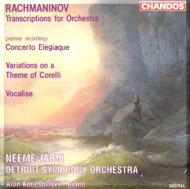
Like Busoni and Darvas wrote orchestral arrangements of the Spanish Rapsody by Liszt for solo piano, Dumbraveanu made an orchestral version of the Variations on a Theme of Corelli by Rachmaninoff for solo piano. Dumbraveanu has taken no shortcuts, orchestrating even those variations that Rachmaninoff allowed to be cut.
.
- Detroit Symphony Orchestra, conducted by Järvi, Neeme
Although I'm not a great fan of orchestral Folias, this is an outstanding arrangement and a great performance in one. Depth and timbres are overclassing the original score in every aspect imho and i know this view will not make me very popular.
Michael Fleming wrote for the slipcase:
Rachmaninov was on vacation in France in 1931 when he wrote the only original piano work of his years in exile: the Variations on a Theme of Corelli.
However the American Record Guide review is less enthusiastic:
It is doubtful whether the seventeenth-century violinist Arcangelo Corelli really inspired Rachmaninov's variations. True, Rachmaninov used the same theme Corelli had in one of his violin sonatas. But Corelli was not its inventor: the simple repeating bass known as La Folia had served as material for generations of composers. Some scholars speculate that Rachmaninov came to know it from Liszt's Spanish Rhapsody, which was part of Rachmaninov's piano repertoire.
In any case, this ancient theme opened the springs of Rachmaninov's creativity again. The piano writing here shows a new economy of means and sparseness of texture, and the twenty variations are organized into a sonata-like scheme, with opening movement, scherzo, slow movement and finale - even a cadenza and coda. Rachmaninov had only sporadic success with the piece in his recitals, but it pointed the way to one of his greatest works, the Rhapsody on a Theme of Paganini for piano and orchestra, which followed three years later.
This is the world premiere recording of the orchestral arrangement by the Rumanian conductor Corneliu Dumbraveanu.
[...]. I wish I could be just as positive about Corneliu Dumbraveanu's arrangement of the Corelli Variations, however, this work doesn't strike me as quite so effective in recreating Rachmaninoff's orchestral medium. Indeed, it often sounds more Romanian than Russian, which is not surprising since Dumbraveanu is Romanian himself. Consider, for example, the Intermezzo or Variation 17. And I found myself at times conscious of the length of the piece, even though few of the individual variations last longer than one minute (Rachmaninoff himself occasionally left out a few of them when playing the piano score in concert). However, Dumbraveanu may be forgiven because of the beautiful oboe solo he has created in Variation 15, here played in melting fashion by the Detroit Symphony's first chair Don Baker. A luscious performance of Rachmaninoff's own arrangement of the well-loved Vocalise is appended to end the disc on a welcome note of repose.
- piano: Alan Kogosowski
- Released by Chandos Records Ltd. compact disc CHAN 9261
- Duration: total 20'23" divided in Theme Andante 0'55", var. 1 Poco più mosso 0'55", var. 2 L'istesso tempo 0'47", var. 3 Tempo di menuetto 0'38", var. 4 Andante 0'52", var. 5 Allegro (ma non tanto) 0'23", var. 6 L'istesso tempo 0'24", var. 7 Vivace 0'33", var. 8 Adagio misterioso 1'24", var. 9 Un poco più mosso 1'55", var. 10 Allegro scherzando 0'33", var. 11 Allegro Vivace 0'18", var. 12 L'istesso tempo 0'33", var. 13 Agitato 0'35", Intermezzo A tempo rubato 1'45", var. 14 Andante (come prima) 1'45", var. 15 L'istesso tempo 1'53", var. 16 Allegro Vivace 0'29", var. 17 L'istesso tempo 0'54", var. 18 Allegro con brio 0'30", var. 19 Più mosso. Agitato 0'29", var. 20 Più mosso 0'53",
- Recording date: October 10 and 11, 1993 in the Detroit Symphony Orchestra Hall
The theme and all variations consist of only the first 8 bars of the original 16 bars, ending in the dominant (similar to the variations of A. Scarlatti).
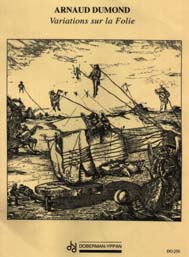 In December 1998 Arnaud Dumond wrote about his 'Variations sur la Folie':
These Variatons on La Folia are part of a group of about
twenty pieces which I call Style Exercises (Exercises de Style). At present
they have been published in various regroupings of which Five French Homages
(Cinq hommages français) and Like a Tango (Comme un Tango) by Éditions
Doberman-Yppan and Differences on Greensleeves (Différences sur Greensleeves)
by Éditions Van de Velde.
Concert pieces as well as exercises, they explore various past styles and
forms in the light of the present-day guitar. Just like that of the interpreter,
the task of the composer consists, among other things, in questioning the
past. One way of evading those untimely yet dear influences is using a more
contemporary language. Which is, in most of the cases, the occasion of transfiguring
the original matter.
These exercises neither parody nor paraphrase, neither replace, nor copy
the original: they just fill in a gap.
Actually, in the age of Ravel, Debussy or Ravel, in the times of Greensleeves
or the Folia, the guitar waited in vain for a composition of its own, making
use of everything within the present reach.
An equally important aim I have set myself is that of evading stylistic
automatisms of the guitar in order to open up a more universal musical realm.
These pieces could appear to be the fruits of the pleasure of visiting "abroad",
meant to be imported into the far too enclosed field of the guitar. Emerged
from imaginary or faraway memories, they are like the 'account of a journey',
in space as well as in time, but departing from and returning to ours.
The Variations on the Folia rely on the regular scheme of the Folia, One
does not have to choose between the sweet sentiment, or the gnashing folly
evoked by the double meaning of the title and by the music. The theme has
an accent on the second beat. Yet each variation contains its own dynamics,
in accordance with its own style.
I have tried to give every variation its own distinguised character, colour
and style. In the first variation the attention is drawn to the bassnote
pattern, which takes the shape of a chromatic scale in the second variation.
The third variation is almost like a march, starting free and easy but ending
in remorseful bitterness. In variation 4 the admosphere is cleared by the
elastic scope of the notes with much suppleness like a never ending phrase
by Mahler, bringing in elements of hesitation and passion. Three bars in
one breath In variation 5 the technique of a lyrical tremolo is introduced
while the melody progresses in the bassline. Variation 6 was inspired by
Rachmaninoff, who composed some monumental
variations upon the Folia-theme in the early thirties. The tension and centre
of gravity in variation 7 and 8 are created by the sustained and repeated
B-note in the upper register. In variation 9 an harmonic ambiguity is shown,
while in variation 10 the abundantly use of left hand 'pull-offs' (mordents)
is responsible for the increasing tension. Variation 11 plays with accused
and blocked rythms, which free themselves in Variation 12, alla flamenca.
The reprise of Variations 4, 5 and 6 brings the work to its fulfilment.
In fact, these three variations are the only ones that do not follow the
traditional pattern of the Folia: they are no more than a transfigured memory.
|
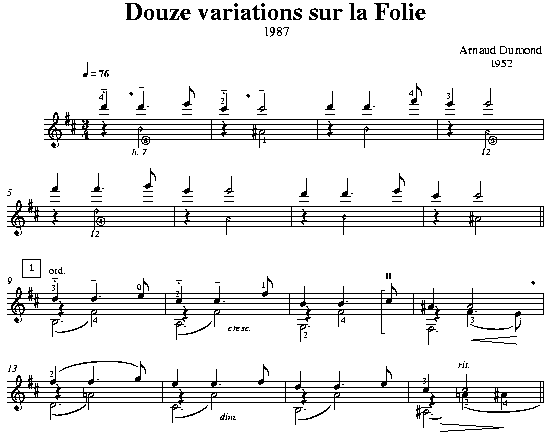
Duration: 1'33", 03 kB. Theme and first variation as indicated below and two more variations |
| Theme and first variation of Variations sur La Folie |
Reproduced with permission of Arnaud Dumond |
|---|---|
 |
|
- Dumond, Arnaud

- Published for guitar by Les Editions Dobermann-Yppan, 1998
- 161 bars
- Publisher No. DO 256
- Dumond, Arnaud (guitar) 'Oeuvres pour guitare, Vol. I'
- Title: Variations sur la Folie
- Guitar built by Antoine Pappalardo
- Released 1998 by Integral Distribution compact disc AD HOC 982
- Duration: 6'44"
- Recording date: 1988 in DS Audio
- Martinez, Kurt (guitar) 'Folías'
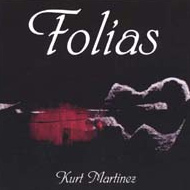
- Title: Les Folies d'Espagne
- Released without indication of year (but it is 2003) by martinezkurt@cs.com without order number
- Duration: 6'53"
- Recording date: not mentioned in the slipcase
- See also the page Recommended Folia-recordings
Joseba Berrocal wrote about this Folía:
This is one of the most well-known books of cello studies and there are a countless number of editions. In fact, near all cellists play them. You will find the original 1806 music in the later edition available at IMSLP. Even if the André edition translated and revised the first part of the method, he used the original Janet et Cotelle plates for the exercices (Plates Number 296)
- Duport, Jean-Louis
- The full score can be found at http://imslp.info/files/imglnks/usimg/9/95/IMSLP26008-PMLP58001-Duport_-_Instruction_on_the_Fingering_and_Bowing_of_the_Violoncello.pdf
- Published 1806 by Janet et Cotelle, Paris, France p. 192-193
- Total of pages 2
- Publisher's No.2599
In his ten movements the composer combines different variations on the folia with refined elaborations of historical themes of rancid ancestry:
"Guárdame las vacas", "Fantasía" de Mudarra, "Tres morillas de Jaén" and "Ay, triste que vengo".
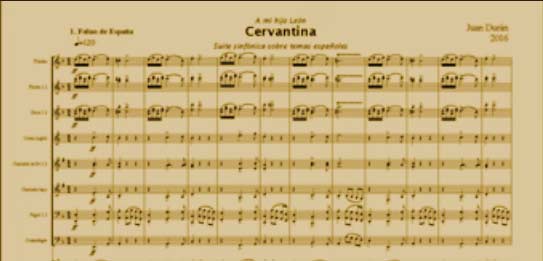
Francisco Martínez Ramos wrote about Cervantina:
The work, a "symphonic suite on popular themes" is a tribute to the music of the time of Cervantes, consisting of variations of themes from the ancient repertoire, such as the "Folías de España". The form is imaginative and the orchestration brilliant.
 |
- ORCAM Orquesta Sinfónica de la Comunidad de Madrid. Dir.: Víctor Pablo
- Recorded in the Auditorio Nacional de Música de Madrid. 27/09/2016.
- Duration ca. 15 minutes
- At YouTube: https://www.youtube.com/watch?v=8EH0oXw6SGg