 In this lovely tune, clearly derived from Boccherini's Fandango, there are some archtypes of musical themes exposed. One of the themes quoted
is the Folia in the last eight bars ending in the tonica.
In this lovely tune, clearly derived from Boccherini's Fandango, there are some archtypes of musical themes exposed. One of the themes quoted
is the Folia in the last eight bars ending in the tonica.
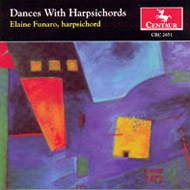
- Funaro, Elaine (harpsichord solo) 'Dances With Harpsichords'
- Released 2003 by Centaur Records compact disc CRC 2651
- Duration: 7'18"
- Recording date: January 5-7, 2001 in the Memorial Chapel, Duke University, Durham, North Carolina
- More about Elaine Funaro at her website http://www.elainefunaro.com/

 One of the finer Folias was detected by Elizabeth Gutteridge. This is an arrangement by Tim Bayley for voice in the
French language and ensemble. There is some resemblance with the mysterious arrangement of
Dos estrellas le siguen. by Les Voix Humaines and Suzie LeBlanc. Both tunes have dark origins. The performers included the Folia chord progression
as integral part of the very old original source. In both tunes the female voice takes the lead part while most Folias are instrumental. The difference is that here the
Folia is actually sung all the way while in 'Dos estrellas le siguen' the instrumental Folia is pasted to extend the beautiful but (too) short vocal line into a
substantial track.
One of the finer Folias was detected by Elizabeth Gutteridge. This is an arrangement by Tim Bayley for voice in the
French language and ensemble. There is some resemblance with the mysterious arrangement of
Dos estrellas le siguen. by Les Voix Humaines and Suzie LeBlanc. Both tunes have dark origins. The performers included the Folia chord progression
as integral part of the very old original source. In both tunes the female voice takes the lead part while most Folias are instrumental. The difference is that here the
Folia is actually sung all the way while in 'Dos estrellas le siguen' the instrumental Folia is pasted to extend the beautiful but (too) short vocal line into a
substantial track.  |
Duration: 0'50", 797 kB. (128kB/s, 44100Hz) |
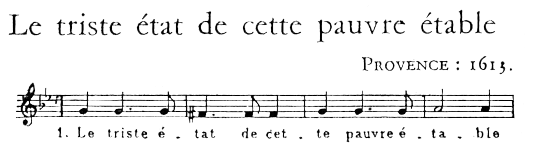
I can shed little light on Le triste état de cette pauvre étable, except that the music is just a single line with no harmony from a French publication of 1942 entitled 'noël! chantons noël!', edited by Paul Àrma. The music page attributes the piece (i) Provence 1613 and (ii) Nicolas Saboly (1614-1675). We just picked on it because it is such a well known tune and had some suitable words !!
| The opening by P. Àrma | 1942, les editions ouvriéres parts, Paris |
|---|---|
 |
|
- Àrma, Paul (original source for The York Waits)
- Title: Le triste état de cette pauvre étable (page 118). As a source Provence: 1613 is mentioned but that would mean one of the oldest melody lines ever of the 'later' Folia tune
- In: 'noël! chantons noël!', 151 Noëls français du XIIIe au XVIIIe siècle.
- Published 1942 by les editions ouvriéres parts, Paris, France
- Publishers No. not mentioned on the cover.
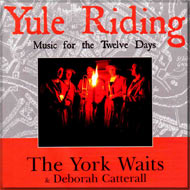
- The York Waits 'Yule Riding, Music for the Twelve Days'
- Released 2004 by Beautiful Jo Records compact disc BEJOCD-46
- Duration: 2'50"
- Recording date: July 7-9 2004 at Holy Trinity Church, Wentworth, Yorkshire, England
- More about The York Waits at their website http://www.theyorkwaits.org.uk