- Jeay, Grégoire (traverso solo)
Grégoire Jeay wrote in an e-mail 12 March 2011:Duration: 6'17" direct link to YouTube
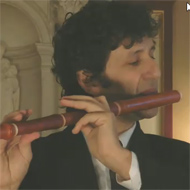
Excerpt of Variations sur "La Folia " as played by Grégoire Jeay
© 2010 Grégoire Jeay, used with permissionI wroteVariations sur "La Folia" only as a challenge and of course inspired by the great master Marin Marais Folies d'Espagne. On the video at YouTube I only played an excerpt of the 17 variations. The music is not yet publisshed and in fact I am looking for a publisher yet. I will record the omposition on the Fidelio label coming May. Although I was born in .Bordeaux, France, nowadays I live close to Montreal, Quebec, Canada.
Let's mention that the March 8th, two days ago, there was a concert of contemporary music on the La Folia theme. Three musicians asked 11 composers to write on La Folia. The trio name "Les Folles Alliees" : Cléo Palacio-Quintin, hyper-flûte et électronique, Elin Söderström, viole de gambe Artiste invitée : Katelyn Clark, clavecin.
Elin Söderström who asked me to write a piece for solo gamba. The tiltle : "La Violia" The other composers are :
Martin Arnold ,Marie-Pierre Brasset, Stacey Brown, Eric Clark, Emily Doolittle, Grégoire Jeay, Chantale Laplante, Analía Llugdar, Tawnie Olson, Cléo Palacio-Quintin et Marie-Claire Saindon.
- Recorded as an excerpt of the variations for YouTube December 2010
- Duration: 6'17" (total duration ca. 20 minutes)
- The music is still to be published and will be recorded May 2011 for the Fidelio label
- Released at YouTube February 23, 2011.
- Jeay, Grégoire (traverso solo)
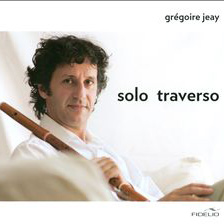
- Title: Variations (15) on the theme of La Folia, for flute & lute
- Released 2011 by Fidelio in mp3-format ordernumber MQ0001917749
- Duration: 11'41".
- Recording date: May 18-19, 2010 and August 28, 2011 in the Church of Ste. Madeleine, Outremont, Montreal, Canada
- More about the oeuvre of the performer/composer Grégoire Jeay can be found at http://www.myspace.com/gregoirejeay
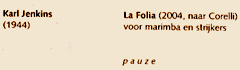 |
| Detail of the program March 5, 2005 |
Karl Jenkins started playing the oboe and saxophone and was a member of the popgroup Softmachine before he became a composer for television and commercials. His successful Adiemus project 'got off the ground' initially due to a television commercial for an airline. Lately his work is frequently performed as a crossroad between popular and concert music.
La Folia is the second piece (in 2002 'Metallum' was written) Jenkins wrote for Evelyn Glennie. It is based upon the Folia-variations by Arcangelo Corelli for violin and basso continuo.
The score was commissioned by IMG Artists (UK) Ltd and Glennie gave the first performance at the Corn Exchange in Ipswich November 23, 2004
Andrew Giddings was at the concert of January 17, 2005 in Southend, UK.:
If I recall correctly, the marimba started fairly simply, and as the piece progressed
(it was quite long) slowly got more aggressive and the Sinfonia played less; the last couple of variations were
almost cadenza-like.
It's hard to judge the piece alone, though. The concert started and ended with ensemble pieces (Brandenburg 3, and a Vivaldi Concerto for 4 violins) by
the Northern Sinfonia, a fairly small ensemble who were absolutely excellent -- played with real drama and feeling for the period, absolutely together,
and with virtuoso skill and lots of enthusiasm. We enjoyed those immensely, and so the works in between -- concertos featuring Evelyn Glennie and/or cellist
Julian Lloyd Webber -- seemed a bit flat by comparison.
And although Glennie is a superb player, I didn't feel that her instruments really suited any of the music.
She played an ottavino concerto on vibraphone, which sustained far too much, and her marimba also took the part of a
cello in a Vivaldi double cello concerto, which didn't really balance properly against
either cello or strings. My other nit-pic was that both soloists seemed to play as if they were in romantic works -- a bit too much rubato and change of mood
and dynamic for baroque works; and the Sinfonia had to play too quietly to give them the necessary space. An interesting experiment, and well worth hearing,
but not as enjoyable as the Sinfonia alone.
Still, the Folia in particular was amazing to watch. She used four mallets at once (two in each hand), flourishing great chords and rolls and semiquaver runs
in a very impressive manner. So in short, yes, it was worth hearing; a little odd, but very well played.
The marimba gives the tune a melancholic and 'native' quality.
And Mrs Resida wrote about the same concert (March 5, 2005):The strings were playing in a low register probably to meet the timbre of the marimba and
that is why the opening of the piece sounded a bit 'Unheimisch' and dramatical compared to the version of
Corelli for violin and b.c.
Fortunately there were some virtuoso soloparts for the marimba because the string section was too massive for a nice balance with the marimba.
The full sound of the marimba simply drowned into all that bowing. Rather striking, because in the other pieces by Vivaldi the quality of the individual
percussion instruments (marimba and vibes) stood out well.
- Jenkins, Karl 'Quirk'
 In the slipcase was written about the composition La Folia:
La Folia (The Leaf, 2004) for marimba and strings, was commissioned by IMG Artists for, and premiered by, Dame Evelyn Glennie. It is based on a violin sonata by Arcangelo Corelli and is in one movement.
- Title: La Folia (the Leaf, 2004)
- Released 2008 by EMI Classics compact disc 50999 5 00235 2 3
- Duration: 10'39"
- Recording date: 2008 in Abbey Road Studios, London, England
- London Symphony Orchestra leader Carmine Lauri. Soloist marimba: Neil Percy
- City of London Sinfonia (founded in 1971 by Richard Hickox), conducted by Nicholas Ward with Evelyn Glennie playing the marimba with six octaves

Detail of ticket March 5, 2005
- Concert tour 24 February 2005 (UK), and March 5 and 6, 2005 in the Netherlands
- Duration: ca. 12'00"
- Recording not (yet?) released
- Manchester Camarata with Evelyn Glennie playing the marimba with six octaves
- Concert 22 January 2005 in Hailfax, UK
- Duration: ca. 12'00"
- Recording not (yet?) released
- Northern Sinfonia with Evelyn Glennie playing the marimba with six octaves
- Concert tour January 11-21, 2005 in the UK
- Duration: ca. 12'00"
- Recording not (yet?) released
 |
Duration: 0'58", 933 kB. (128kB/s, 44100Hz) |
Alex Stroud plays the entire piece in a live performance
|
La Folia Folio was commissioned by Canadian guitarist Harold Micay. He wanted a work that he could splash around in. The result is a set of variations based on the chord progression from the famous theme La Folia d'Espagna. That work has a rich and long history of attracting composers. There are sets of varations by A. Scarlatti, C.P.E. Bach, Vivaldi, Corelli, Liszt, Nielsen and Rachmaninoff, not to mention dozens of sets by guitar guys like Sanz, Corbetta, Sor and Giuliani. I have tried to stress the dance nature of the theme by using only the harmonic progression, omitting the melody altogether, though there is a weird paraphrase of it about halfway through. The work is a blast to play and I enjoy splashing in it as often as I can.
David Tanenbaum played 'La Folia Folio' as part of his concert tour in the USA, Canada and Germany, January-April 1998 (source: Tom Welsh, New Albion Records)- Borbye, Anders 'Refolia, contemporary works for guitar'
- Title: La Folia Folio (1995)
- Released October 2008 by Gateway ordernumber AB001
- Duration: 10'44"
- Recording date: August-September 2008 in the Frederikskirken, Aarhus
- See also the page Recommended Folia recordings
- More about Anders Borbye at http://www.andersborbye.dk
- Brown, Elizabeth C.D. (modern classical guitar) 'La Folía de España'
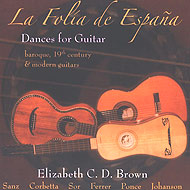 Elizabeth Brown wrote for the slipcase:
Bryan Johanson is a native of Portland, Oregon, and is a Professor of Music and founder of the guitar studies program at Portland State University. His catalogue of over eighty compositions reflects a wide variety of interests that extends far beyond the guitar. He has written several substantial works for solo guitar, and in recent years has focused a major portion of his energy on writing chamber music for the guitar.
The emphasis on the harmonic progression is most similar to the folía settings by Corbetta and Sor, where the inherently chordal and rhythmic nature of the guitar is showcased. Although La Folia Folio is clearly in a modern idiom, the faster tempo and many special effects evoke the wildness of the earliest folías.- Title: La Folia Folio
- Released 2005 by Rosewood Recordings compact disc ROSE 1007-CD
- Duration: 11'40"
- Recording date: Fall 2004, at Queen Anne Christian Church, Seattle, Washington, USA
- Johanson, Bryan (guitar) 'Folio, music for guitar alone by Bryan Johanson'
- Title: La Folia Folio
- Released 1996 by Gagliano Recordings compact disc GR 602-CD
- Duration: 10'35"
- Recording date: March 24/25, 1996 in Lincoln Performance Hall, Portland State University, Portland, Oregon.
- Partington, Michael (modern classical guitar) '20th Century Guitar Volume II'
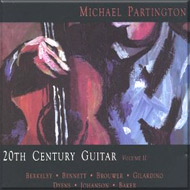 Paul Fowles wrote in the Classical Guitar Magazine:
Bryan Johanson's ten-minute exploration of Las Folias... remains a worthy vehicle for Partington's considerable technical powers...
- Title: La Folia Folio
- Released 2000 by Rosewood Recordings compact disc ROSE 1004-CD
- Duration: 10'22"
- Recording date: unknown
- Stroud, Alex (guitar)
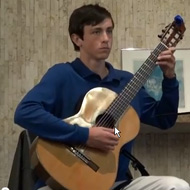
- Title: La Folia Folio
- Published at YouTube 15 February 2012 by dnworks
- Duration: 10'22"
- Recording date: February 2012 in a Master Class with Johannes Moller, South Bay Guitar Society
 I have been told that the 'Sinclairs Visan' originally is a Swedish drinking
song or a political song derived from La Folia note for note. There are more
than 60 different local variations of this tune with all sorts of texts. More
information (unfortunately only in the Swedish languague) is to be found at
http://www.abc.se/~gor/musik/folia.html
I have been told that the 'Sinclairs Visan' originally is a Swedish drinking
song or a political song derived from La Folia note for note. There are more
than 60 different local variations of this tune with all sorts of texts. More
information (unfortunately only in the Swedish languague) is to be found at
http://www.abc.se/~gor/musik/folia.htmlJan Johansson had a fine reputation for his ability to arrange jazz interpretations for Swedish folk songs.
The vinyl version of the original performance
|
- Jan Johansson 'Musik genom Fyra sekler' (Music from the past four centuries).
- Title: Sinclairsvisan
- Arrangement for jazz-piano, bass, guitar, flute and tin wistle
- Released 1969 3-LP-set Megafon MFLP S12-14, re-released by Heptagon double compact disc HECD-002
- Duration: 5'18"
- Recording date: September 24 till October 9, 1968 in the studio of the Broadcasting-house in Stockholm.
Commissioned by Keri McCarthy for the International Double Reed Society 36th Annual Conference.
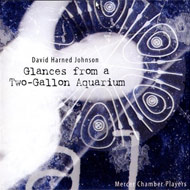
- Mercer Chamber Players 'Glances from a Two-Gallon Aquarium'
- Title: La Folia
- Released 2009 by ACA Digital Recording Inc. compact disc
- Duration: 10'06"
- Recording date: unknown
Commissioned by Fay S. Carter for the Minnesota Woodwind Quintet
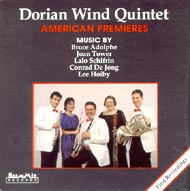
- Dorian Wind Quintet (Mann, Elizabeth [flute], Reuter, Gerard [oboe],
Kirkbride, Jerry [clarinet], Taylor, Jane [bassoon], Rose, Steward [horn]
'American premieres'
Wallace Rave wrote for the slipcase:The Variations on the Spanish La Folia by Conrad De Jong rests within a tradition of extraordinary durability. The Portugese - Spanish Renaissance dance music pattern, La Folia, was said to reflect madness of an empty head, doubtless a reflection of the dance style. The version which emerged in late seventeenth century France was an isomatric harmonic progression accompanying a melody marked by sarabande-like dotted rhythm. De Jong's contribution to the form demands soloistic virtuosity from each instrument in variations three through seven. The theme in its traditional harmonic garb first appears in its entirety only within the second variation, where it is complemented by obligato figures. Supplementing the motivic material supplied by the theme is a derived motive heard in the brief introduction, which is a permutation of the initial three pitches of the original melody. In the eighth variation, the motive initiates a gradual reversion to the Folia melody which concludes the work
Robert S. Howe wrote in an oboe review:This quintet presents an introduction, 8 variations on La Folia, and a final statement of that theme. It is in an appropriately modern idiom (being completed in 1985) and requires good players, but is always approachable for both players and audience. Each member of the quintet takes a turn as soloist, but the real star of this piece is the bassoon; variation 6 has three extended bassoon cadenzas, presenting the bassoonist as a jazz soloist a la Coltrane. Scoring is effective and the horn, often a sticky point in woodwind quintet music, is very well handled, adding weight by intelligent use of its middle register without being overbearing. The parts are of moderate difficulty, the oboe never goes above F and the bassoon, above Bb. The Variations will be best suited for established quintets that wish to expand their repertoire to include an effective and somewhat modern work.
- Released 1990 by Summit Records distributed by Koch International compact disc DCD 117
- Duration: 12'06"
- Jong, Conrad de
- Published by Josef Marx Music, 236 W. 26th Street 11 S., New York, NY 10001-6736 c. 1988
- Score 41 p. and 5 parts, 34 cm
Improvisation is not a skill often associated with the Folia theme for performance practice in front of an audience or a recording. However the Folia theme is a most favorable subject for students to play together since most classical music students will be familiair with the theme. Improvisation needs skill and a mind setting, which is not often learned at conservatories nowadays. Perhaps it is quite a different approach to music.
Karst de Jong wrote in an e-mail March 10, 2013:
The two performances of improvisation based upon the Folia theme which are available at the web differ completely. Not a single note is written down and I use the theme as a vehicle for the instant improvisation
My inspiration to pick the Folia theme of all music is that originally it is considered as a musical framework consisting of bass, melody, harmony and rhythm suitable to improvise upon. I try to take this practice a step further and use the theme as inspiration of my improvisations. It comes and goes whenever it is convenient or spontanuously my mindset leads that way during a concert. The version on YouTube was created at the spot and got its shape without any planning. It is quite impossible to play it once more without writing down all the notes. The Folia improvisation I recorded for Improdisiac had a similar treatment. It was recorded in one take and it is a different approach and atmosphere.
- Jong, Karst de (piano)
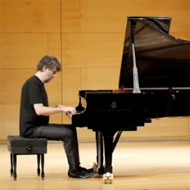
Karst de Jong improvises on the Folia theme, Vila-seca Music Festival 2011
Duration: 9'13" direct link to YouTube
© 2011 by Karst de Jong, used with permission- Title: Improvisation on the theme of 'La Folia d'España'
- Published at YouTube September 23. 2011 by Karst de Jong
- Duration: 9'13"
- Recording date: September 8, 2011 during the Vila-seca Music Festival 2011 in the Auditori Josep Carreras Vila-seca, Tarragona, Spain
- Grand piano: Steinway D.
- Jong, Karst de (piano) 'Improdisiac'
- Title: La Folia (a different version due to the technique of improvisation than the one mentioned above)
- Released 2012 by Karst de Jong compact disc order number 885767171695
- Duration: 6'29"
- Improvisation by Karst de Jong
- Recording date: February 21, 2012 near Tarragona, Spain on a Steinway D grand piano
- Available at http://www.cdbaby.com/cd/karstdejong
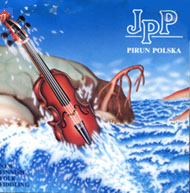
The Lampaan Polska is a traditional Finnish folktune consisting of 32 bars. The opening 16 bars are absolutely similar to the Folia melody- and chord progression. The only way to determine if the Lampaan polska is involved, is listening to the following 16 bars, which are standard and a kind of response to the Folia theme. You can get an impression of the scheme of the polka by listening to the midi of the sheet music by Toivo Kuula, who made a complicated (full of dissonants) arrangement for piano of the Lampaan polska.
JPP starts off in a slow pace repeating the Folia-theme, before the 16 ending bars of the polka are played only once. Now the full polka is played, the rhythm is stirred up and all violins participate in a a folky way of playing the Folia-theme, turning it in a fancy dance tune, which brings it almost back to its original function in the 17th century.
- JPP 'Pirun Polska, new Finnish folk fiddling'
- Title: Lampaan Polska
- Released 1992 by Olarin Musiikki Oy, Finland cd OMCD 37
- Duration: 2'52"
- Recording date: Febuary and April 1991 in Salonkylä
- 5 fiddles, upright bass and harmonium
- JPP 'Devil's Polska, new Finnish folk fiddling'
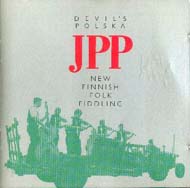
 Although the facts are missing to confirm it, I guess this recording is
a re-release of the album mentioned above.
Although the facts are missing to confirm it, I guess this recording is
a re-release of the album mentioned above.
- Title: Lampaan Polska (= sheep's polka)
- Released by Green Linnet (USA) compact disc 1993
- Duration: 2'52"
- arranged by Timo Alakotila and Arto Järvelä
- Recording date: not indicated
- JPP 'History'
Although the facts are missing to confirm it, I guess the track of lampaan polska mentioned above is included in this compilation
- Title: Lampaan Polska (= sheep's polka)
- Released 1999 by Northside compact disc NSD 6026
- Duration: 2'52"
- arranged by Timo Alakotila and Arto Järvelä
- Recording date: not indicated
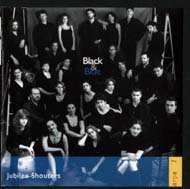 This a cappella tune starts at 2'43" with the Folia-bass in unison, followed
by a variation with contrapunt and the second variation includes a third voice,
before continuing to another melody.
This a cappella tune starts at 2'43" with the Folia-bass in unison, followed
by a variation with contrapunt and the second variation includes a third voice,
before continuing to another melody.
- Jubilee Shouters, Gianna Grazzim director 'Black & Blue'
- Released 1997 by Radio Popolare Sensible SSB 009, Arpa 7
- Arranged by Bruno Tommaso
- Duration: 5'39"