
| |
|
La Folia (pronounce as 'lah foh-LEE-ah'), literally meaning madness, folly, or empty-headedness is one of the most remarkable phenomena in the history of music. This simple but intriguing tune was first published in 1672. Its roots go back to the 16th century. It would remain a major challenge for numerous composers up to the present day; ranging from a part of a famous Bach Cantata to a popular film tune in the hit charts by Vangelis. The flexibility of the theme to incorporate and adapt features of new musical styles is not only amazing but also essential for its survival. Another striking feature is the variety of instruments used to play the theme in a completely natural way. How about bassoon, bird-organ, brass quintet, carillon, clavichord, English handbells, mandolin, nyckelharpa, rebab, salterio, sitar and ukulele to name a few?
In most literature La Folia ceased to exist in the middle of the 19th
century with a convulsion in the 1930's with the variations by Rachmaninoff and Ponce.
But in fact the theme of La Folia has never been so popular for
composers as in the last decades.
The most striking feature of La Folia, however is that the theme is not well-known to a
larger public, although more than 150 composers for over 330 years made lots
of brilliant variations. I hope this site will contribute to the fame La Folia
deserves in the history of music.
 |
Richard Hudson |
In 1937 Mary Neal Hamilton (p. 24, 149) claimed
it was Gaspar Sanz who wrote the original
famous 'later' Folia but other authors point at the key role Francesco Corbetta played.
Personally I assign great authority to Falconieri who
already in 1650 published a Folia with all the features of the later Folia presented
except for the standard melody but there is already a very slow chromatic variation (stretching the chords over the bars).
To make things even more confusing the 'later' Folia chord progression is already
detectable in the Fitzwilliam Virginal Book which can be traced back to 1618 as part of an anonymous tune called Pakington's Pownde (which manuscript was only 'rediscovered' in 1740 so its role in popularizing the Folia-theme is limited).
However at Venice the later Folia chord progression was published in Uccellini's Sinfonia 5 dated back to 1660.
Since 'borrowing' music was common practice in the 17th Century it is
very difficult to establish who borrowed or adapted this tune from whom.The fact is that
it evolved from existing tunes and the role of Lully, who definitely had the help of André Philidor, the oboe specialist of the time,
can easily be overestimated.
The name "Folia" is of Iberian origin and refers to a fertility dance in three-four time originating in the late 15th century. The first time the name emerges is in a text by the Portuguese dramatist Gil Vicente entitled "Auto de Sibilla Cassandra". In music Folia meant, at least till the 1670's, a very quick-paced and tumultuous dance, in which the dancers carried men dressed as women upon their shoulders. They were literally driven mad by the noise and the stirring rhythm.
There were still many different basic themes and there was not
one single fundamental melody that dominated the rest for the so called 'early' Folia. These Folias became
very popular in Spain and Italy.
Through the adaptation of the rhythm and the catchy melody into
some kind of solemn passacaglia, La Folia gained popularity,
not in the least in the higher circles of society.
Jean-Baptiste Lully in 1672 composed the perfectly symmetrical
musical edifice which has inspired many composers up to the
present day to write their own variations for a
diversity of instruments and orchestrations, varying
from 3 'simple' variations for solo harp to 24 variations for
a full symphonic orchestra (Salieri).
 |
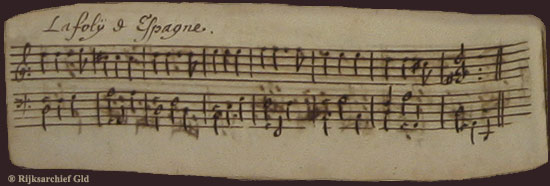
Another detail of a dutch manuscript as part of the family-archive Bosch, van (von) Rosenthal and relatives dated back to the year 1695. |
We will here concentrate upon the version perfected by Lully, the so called 'later' Folia, because the structure is easily recognizable (although it becomes more difficult with the modern elaborated ones), and also because there is so much fascinating material available derived from this wonderful version alone, which flourished particularly in France and England.
Composers in Germany (apart from W. Abel) seem
to have avoided any involvement with the 'early' or 'later' folia theme
until this century, while in the Scandinavian countries the later Folia became
entangled in the traditional folksong culture.
Jan Ling wrote about the Folia: "A very typical wandering melody is "La folia," with its unique rhythmic and melodic profile (New Grove, vol. 6, p. 691). All kinds of texts have been set to it, from children's and calendar songs to political songs".
In Finland, for instance,
the tune was extended with another 8 bars (which are repeated
to restore the symmetry) as an answer to the Folia theme and is
widely known as the Lampaanpolska. In Sweden the tune is known as
Sinclairsvisan and it must have been quite popular at the time when
Anders Odel (1718-1773) wrote a text on the melody. There
are many local variants of this tune and texts circulating in Sweden
to give it a political character. It is believed that the song contributed
to the political upheaval against the Russians because it often describes
in one way or the other the murder of a Swedish diplomat in 1739 the rumor even goes by the Russian government. We can detect a Norwegian Folia quite similar
to the Lampaanpolska and Sinclairsvisan in one of Edvard Grieg's arrangements of
Norwegian Folksongs and even the rumour goes that in Iceland the Folia is known
mainly as a drinking tune but with a very different text than the Swedish version.
However, I have not yet found concrete evidence for the Iceland version.
The later Folia also found its way into the popular folksong culture in the Low Countries, where quite a number of spiritual
and secular songs set to the tune of the 'Folies d'Espagne' were published during the 18th century according to the study of Erik Bosgraaf and some sources at the Digitale Bibliotheek voor de Nederlandse Letteren (Digital Library of Dutch Literature.
| THE FRAMEWORK OF THE LATER FOLIA | |
|---|---|
|
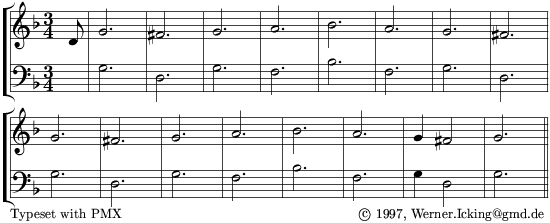
the basic chord progression in the key of d minor, the key that's most often used for the later Folia: /DM___ /A7___ /DM___ /C___ /F___ /C___ /DM___ /A7___ / /DM___ /A7___ /DM___ /C___ /F___ /C___ /dm A7__/DM___ / | |
 |
The framework twice with the melody added the second time. Duration: 1'16", 2kB. |
| The framework in the key of g minor | by Hudson, Vol I, p. XVIII |
 |
|
Richard Hudson (p. xvi, Vol 1) compares some
features of the 'early' and 'later' Folia. They are both in triple
meter, have more or less parallel halves with the mid-cadence on V
but the differences are even more interesting. To name a few without
getting into too many details: the chief musical
distinction concerns the rhythmic structure, which has its opening
accent in the earlier type on the dominant (V chord), in the latter type on the tonic (I-chord).
The early folia may use a major or minor tonic chord or mix them
within a single statement, whereas the later folia uses a minor tonic
chord. The accents in rhythm in the early folia with its fast tempo are
caused by chord changes in the second beat, while in the later folia
there are hardly any chord-changes within a bar (except for bar 15),
so the accent is caused by dotted 2nd beats of melody, especially
in odd-numbered measures.

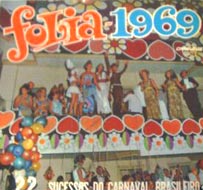
Quite independently from these works, the Folia is also
a folk song in the Canary Islands, slow and lyrical in character
and usually accompanied on the guitar or the timple,
a small guitar of the Canary Islands. Sometimes this folk song is also used
in art music like the 'Folias Canarias' written by Joaquín Rodrigo in 1948.
The Brazilian culture which is rich with Afro-Brazilian folklore and traditions is known for his 'Folia de Reis'
which means 'Folly of the Kings'. It is the name of a celebration brought to Brazil by African slaves in the
18th century; it is a secular version of the Bible story of the three kings, or Magi, and runs from December
24 to January 6.
Because there is no direct relation with the earlier mentioned musical structure
these Folias will be ignored here.
best viewed at 800 x 600