I received some nice suggestions for intriguing variations
which are very similar to the technique of the Folia-variations.
I enjoy listening to these variations and expect that other
people interested in Folia-music, will appreciate these pieces too. With a lot
of thanks to the people who made these contributions.
- Anonymous (16th or 17th
century)
- Cumh Easpuic Earra-ghaeidheal, lament for the Bishop of Argyll
Jack Campin wrote about this tune:
This tune is from the Macfarlan Manuscript of Scottish fiddle
and flute tunes (National Library of Scotland MS.2084/5), compiled by David
Young in Scotland around 1740 for the antiquarian Walter Macfarlan (book
III #34 p20). It's obviously much older, but there is no earlier source
for it. The structure is like a piobaireachd (bagpipe variation set) but
the range is too wide for the pipes. Some people think it was originally
for the harp. The tune might just possibly be indigenous Gaelic, but the
basic rhythm is so Folia-like that a foreign influence seems more likely.
If it was a harp tune, that would make sense, as harpers had international
connections.
There were two possible bishops it could have been dedicated to; they lived
about 100 years apart. And there is another tune of the same name from another
Scottish manuscript of the 18th century. David Johnson thinks this one was
for the earlier bishop, who died in the late sixteenth century.
This has been recorded on the fiddle (by Mary-Ann Alburger, I think). There
is a published version of it in Scots on the Fiddle, book 2, edited by David
Johnson and available from him at 8 Shandon Crescent, Edinburgh EH11 1QE,
Scotland (phone 0131 337 4621). The other bishop's lament has been recorded
on the harp.
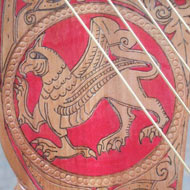
- Chadwick, Simon (early clàrsach = Gaelic harp) 'Clàrsach na Bànrighe'
 |
Duration: 1'00", 942 kB. (128kB/s, 44100 Hz)
The opening of Cumh Easpuic Earra-ghaoidheal by Simon Chadwick
© 2008 by Simon Chadwick, used with permission |
The booklet says:
There are two different tunes preserved that bear the title,
‘Lament for the Bishop of Argyll’; the other one is well known,
having been recorded by Alison Kinnaird. This less well known one
survives in the fiddle manuscript beautifully written out by David
Young for his patron Walter MacFarlane, in c.1740. We do not know
which bishop either lament might have been composed for, nor how
ancient this tune was when David Young wrote it down. Its structure
is very reminiscent of pìobaireachd, having its tune or ground
developed in a melodic variation, which is then developed by
figural variations of increasing complexity.
- Title: Cumh Easpuic Earra-ghaoidheal
- Released 2008 by Early Gaelic Harp Info compact disc EGH1
- Duration: 6'44"
- Recording date: 21st-24th January 2008, in a medieval vaulted chamber in the ruins of St Andrews cathedral, Scotland
- More about Simon Chadwick and his recordings at http://www.earlygaelicharp.info/CnaB/
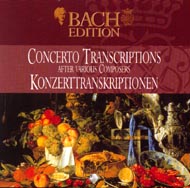
- Bach, Johann Sebastian (1685-1750)
- (Allegro) Adagio of Concerto in D minor after Johann Ernst von Sacksen-Weimar
(BWV 987, ca. 1708-1717?)
 |
Duration: 2'36", 11 kB.
The theme and variations of the adagio of BWV 987 |
- Dirksen, Pieter (harpsichord) 'Concerto Transcriptions'
- Title: (Allegro) - Adagio, Concerto in D minor after
Johann rnst von Sachsen-Weimar
- Released 2000 by Brillant Classics (Het Kruidvat) compact
disc 99372/4
- Duration: 2'37"
- Recording date July 4-8, 1999 in Maria Minor Utrecht,
the Netherlands
- Harpsichord built by Sebastian Nuñez (after Johannes
Ruckers, 1638)
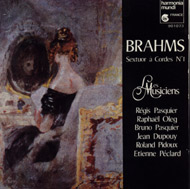
- Brahms, Johannes (1833-1897)
- Andante, ma moderato from Sextuor a cordes No. 1 en Si bemol majeur, Opus
18.(B-flat major sextet nr. 1)
|
|
Berliner Philharmonik Oktet
Duration: 10'20" direct link to YouTube
© Berliner Philharmonik Oktet |
- Les Musiciens: R. Pasquier, R. Oleg, B. Pasquier, J. Dupouy, R. Pidoux,
E. Peclard
Ginette Keller wrote as an introduction in the slipcase:
The Sextet, Op. 18, sometimes known as the 'Spring' Sextet,
becoming a nickname for his happy work, was completed in September 1860
and, according to Clara Schumann, made a strong impression. Although
it is his first important work of chamber music, this Sextet is far
from being one of Brahms's first compositions.
The second movement is a theme and variations. It is well known how
fond Brahms was of this form which permitted him to combine discipline
with imagination. 'I do sometimes find, however, that we ... brood
too much on the theme. We all hold on timidly to the melody, but do
not treat it freely...' The theme can be broken down into two phrases
of eight bars each. It is a very simple tune built out of an ascending
scale. The harmonies, too, are simple, but with a hint of colour. The
overall character is grave - key of D minor - , a little ponderous -
vertical writing with double and triple stopping. This is reminiscent
of both the folksong and the chorale, both of which are often fused
in the popular imagination of Lutheran Germany.
- Released 1982 by Harmonia Mundi compact disc HMC 901073
(ADD)
- Duration 10'14"
- Recording date: October 1980 & 1982
- Casella, Alfredo (1883-1947)
- Variations sur une chaconne Op. 3 (1903)
12 sections (Theme, 10 variations and Final)
[Theme] Largement
Var.1: Un peu plus vite
Var.2: Un peu plus vite
Var.3: Agité
Var.4: Modéré
Var.5: Allegro
Var.6: 1er Mouvt (F major)
Var.7: Modérément vite (F major)
Var.8: Allegro (F major)
Var.9: Vite
Var.10: Allegro
Final: Allegro, ma non troppo
|
|
Variations sur une chaconne by Bruno Canino
Duration: 7'31" direct link to YouTube
© Bruno Canino |
 |
The complete sheet music of Variations sur une chaconne
Direct link to the IMSLP.org
© IMSLP
|
| The opening (theme) of Variations sur une chaconne by Casella |
|
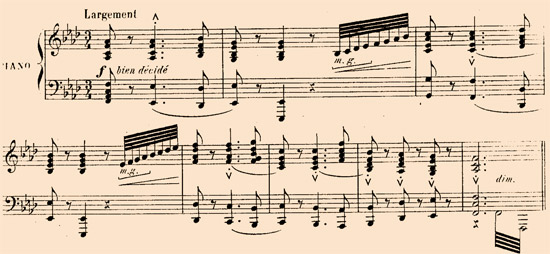 |
The La Folia tune goes like (chord progression):
dm/// a7/// dm/// c/// f/// c/// dm/// a7///
dm/// a7/// dm/// c/// f/// c/// da7/ dm///
while the theme of Variations is an almost similar progression (transposed to dm):
dm///c7/// am/// c7/// besm//am/// gm// /dm///
where / stands for a beat or count.
- d’Ambrosio, Michelle
- Released 2014 by Brilliant Classics 3 cd-box
order number 9281
- Duration: 8'13"
- Recording Date: unknown
- Children of Bodom (ensemble)
- Kissing the shadows
|
|
Children of Bodom
Duration: 4'40" direct link to YouTube
© Children of Bodom |
Well, this is rough stuff you might say: a Finnish 'melodic death metal'-band. They play
very close to the Folia-theme in a 2/4 meter. The theme is only a part of the song and is introduced
three times, when you consider the paired repeats as one
| |
Duration: 0'25", 932 kB. (128kB/s, 44100 Hz)
Fragment of Kissing the shadows with the almost identical Folia-theme |
 The La Folia tune goes like (chord progression):
dm/// a7/// dm/// c/// f/// c/// dm/// a7///
dm/// a7/// dm/// c/// f/// c/// da7/ dm///
while Kissing the shadows has an almost similar progression: (transposed from the original key of Cm to Dm)
dm// a7// dm// a7// f// c// dm// a7//
dm// a7// dm// a7// f// c// dm// a7//
where / stands for a beat or count. So the Folia almost always starts in 3/4
meter while this tune is in 2/4 but there are plenty variations where the
rhythm switches to 2/4 in the Folia too.
- Children of Bodom 'Follow the reaper'
- Released October 30th, 2000 by Spinefarm compact disc without odernumber
- Duration: 4'39"
- Recording Date: August till September 2000 at Abyss Studios, Sweden
- Draghi, Giovanni Battista (c.1640-1708)
- A ground
Source: Edinburgh, National Library of Scotland, Inglis 94 MS 3343. Keyboard manuscript, ca. 1695 An arrangement was published for woodwinds in "The Division Flute" (1702).
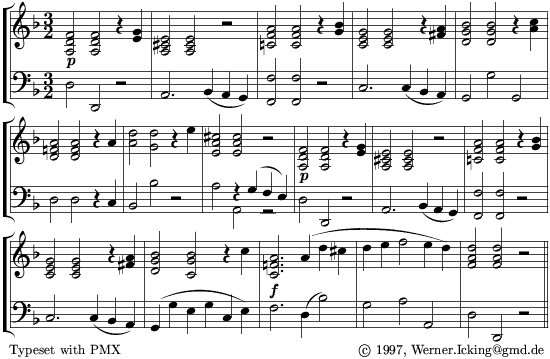
Giovanni Battista Draghi was an Italian keyboard player who went to England. The original music was probably intended for solo keyboard. A lovey ground with variations over 8 bars.
| The sheet music for keyboard solo |
Typeset by Don Simons using PMX |
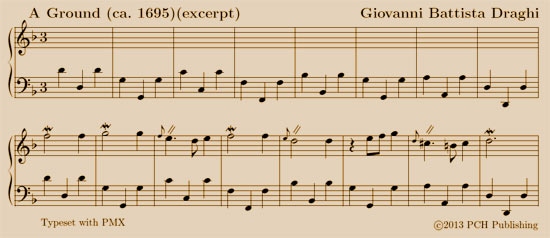 |
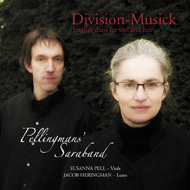
- Pellingmans'Saraband (Susanna Pell: viol, Jacob Heringman: lute) 'Division Musick, English duos for viol and lute'
|
|
Italian ground as played by Pellingmans'Saraband
Direct link to YouTube
© 2012 by Pellingmans' Saraband |
- Title: Italian ground
- Released 2012 by Magnatune compact disc
without oder number
- Duration: 4'20"
- Recording date February 6-8, 2012 at St. Agatha's Church, Easby
, England
- Enja (ensemble)
- Promentory
This music was not originally composed by Enja if I am correct:
|
Duration: 2'08", 14 kB.
Promentory as sequenced by Olivier S. Descamps and used with permission
© 2003 Olivier S. Descamps |
Olivier Descamps wrote about the origins of this music:
Can also give you some more information about the music
"The Last of The Mohicans " Actually, it was not composed by Enya but by
a certain Dougie Maclean (the music was called 'The Gael') and was adapted
for the movie by Trevor Jones (This information are those found on the pocket
of the CD).
I have searched very hard to find the original music 'the gael' but
so far, I did not find it. More detailed information about the origins of
the tune can be found at http://www.musicweb.uk.net/Programme_Notes/macLean_thegael.htm
|
|
The Gael by Dougie MacLean
Duration: 3'59" direct link to YouTube
© Dougie MacLean |
Starting like the Folia in d minor this piece is a simple repetitive theme
over 8 bars but not that complicated as the folia theme. The dominant septime
is no part of the chord progression
The La Folia tune goes like (chord progression):
dm/// a7/// dm/// c/// f/// c/// dm/// a7///
dm/// a7/// dm/// c/// f/// c/// da7/ dm///
while the promentory-tune has an almost similar progression:
dm//// dm//// c//// c//// f//// c//// dm//// dm////
where / stands for a beat or count. So the Folia almost always starts in 3/4
meter while this tune is in 4/4 but there are plenty variations where the
rhythm switches to 4/4 in the Folia too and the repetitive character of the
tune is in the same spirit as the Folia. For one thing the dominant septime
(A7) is missing in the tune which is very prominent in the Folia-theme. If
i am correct i can hear the a minor as a chord in the second part of the tune.
The music looks very similar to the film music by Newton Howard for the film
Restauration where the Folia theme is repeated several times. So typically
suggestive film score music.
- Enya 'Last of the Mohicans'
|
|
Last Of The Mohicans Promentory
Duration: 6'13" direct link to YouTube
© Enya |
- Released by unknown
- Duration: 6'13"
- Recording Date: unknown
- Gilkyson III, Hamilton H. (1928-1999)
- Greenfields
|
Duration: 1'33", 06 kB.
Greenfields as sequenced by Olivier S. Descamps and used with permission
© 2003 Olivier S. Descamps |
Olivier S. Descamps wrote about this tune:
Hamilton H. Gilkyson III, nicknamed 'Terry' Gilkyson wrote this music in partnership with Richard Dehr and Frank Miller
'Greenfields' was a Top 10 hit in 1960 performed by 'the Brothers Four' which was an American folk group founded
in 1957 in Seattle Washington. Other highlights this group performed included
"The Green Leaves of Summer" from the John Wayne movie
The Alamo (1961).
The La Folia tune goes like (chord progression):
dm/// a7/// dm/// c/// f/// c/// dm/// a7///
dm/// a7/// dm/// c/// f/// c/// da7/ dm///
while the Greenfield-tune has an almost similar progression:
dm / a7 / dm / c / f / c / d / a7
- The Brothers Four 'Greenfields & other golds'
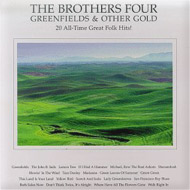
|
|
The Brothers Four
Duration: 3'04" direct link to YouTube
© The Brothers Four
|
- Title: Greenfields
- Released 1997 by Folk Era Records compact disc 1434
- Duration: unknown
- Recording date February 1960
GREENFIELDS
Once there were greenfields...kissed by the sun
Once there were valleys...where rivers used to run
Once there were blue skies with white clouds high above
Once they were part of an everlasting hope
We were the lovers who strolled through greenfields
Greenfields are gone now...parched by the sun
Gone from the valleys...where rivers used to run
Gone with the cold wind that swept through to my heart
Gone with the lovers who let the dreams depart
Where are the greenfields where we...used to roam?
I'll never know what made you run away
How can I keep searching when dark clouds hide the day?
I only know there's nothing here for me
Nothing is now left for me to say
But I keep on waiting...until you return
I keep on waiting until the day you learn
You can't be happy when your heart's on the roam
You can't be happy until you bring it home
Home to the greenfields...and bleed once again
- Händel (Handel or Haendel),
George Frideric (1685-1759)
- Sarabande in D Minor, harpsichord suite nr. 11 in D minor, Book II (1727)
|
The complete suite (HWV 437) including the famous sarabande for keyboard
Direct link to the IMSLP.org
© IMSLP
|
This tune with the same sort of framework and idea as the Folia is often called
Händel's Folia. Everybody can hear that it is no Folia but since Händel
did not write any Folias at all and this piece breaths the same atmosphere, and most likely
Händel had the Folia-theme in mind when composing this Sarabande, it became
known as 'Händel's Folia' in much the same way as the widespread misunderstanding
that 'Take Five' was written by Dave Brubeck because his quartet always played the piece.
The similarities between the Folia-theme and the Sarabande by Händel are striking in any way:
theme and variations over 16 bars with two regular eight measure phrases, rhythmically the dotted value
on the second beat of each measure and the same sort of voicing in upper and lower register.
It seduced Richard Yates to write:
So, aside from this theoretical analysis, what do you think? Does Händel's 'Sarabande'
have that 'folía feel? Will you be hearing echoes of it in a multitude of other compositions?
Will you be humming it to yourself for the next five hundred years? Then that's a folía!
Johan Halvorsen arranged the theme for violin and viola in 1897 (theme and 11 variations). The sheet music of Halvorsen can be found in the public domain at The Petrucci-Library
The popularity of Händel's Sarabande is immense after launching the arrangement for an
orchestral setting in the film of Stanley Kubrick.
It was shamelessly copied by the World Wildlife Fund (The Netherlands) and later
on by Levi's Jeans (Europe, 2002) for their commercials. Even the dutch radio broadcasting
of VPRO's 'Boeken'(1984/5) was weekly introduced by the film music of the
film by Stanley Kubrick. In 2005 the BBC-documentary-series 'Auschwitz: The nazis and the final
solution' was paved with it and Brian De Palma featured the orchestral version as the overture for his 2007 film Redacted. Michael Winterbottom included this sarabande in "A Cock and Bull Story" in an arrangement by Michael Nyman. The commercial for Flemish Duvel beer joined the ranks in 2007. I am sure many more examples will follow.
The classical prototype of 'Stolen Music', to take
your own precious feelings and association away for a fragment of a film or
a bloody commercial. Such abuse should be prosecuted.
|
|
Duration: 0'30" direct link to YouTube
Commercial: Levis Engineered Jeans 'Freedom To Move', the 30 seconds version (which is more than long enough) |
|
|
Duration: 0'48" direct link to YouTube
Commercial: Duvel Beer
© 2007 by Duvel Beer |
Ken Whitcomb wrote as an introduction to his midifile:
The confusion regarding the legitimacy of the various editions
of Händel's Suites is justified. Not only did Händel publish two
sets himself but many unauthorized versions were printed as well. Moreover,
even the authorized printings were not always correct.
Händel commissioned John Cluer to publish the first set of Suites de
Pièces pour le Clavecin in 1720 after pirated copies were printed by
John Walsh with false title pages indicating they had been published in Amsterdam.
To confound Walsh's edition, Händel revised the Suites to encourage people
to buy the 'correct' version. Later, in 1732, Walsh published the second set,
this time with Händel's permission. This set consisted mainly of the
'Amsterdam' edition with some new material.
the basic chord progression of Händel's
Sarabande in the key of d minor
Note the difference with the folia-chord
progression
/DM___ /A7___ /F___ /C___ /GM___ /DM___ /GM___ /A7___ /
/DM___ /A7___ /F___ /C___ /GM___ /F___ /GM A7__/DM___ /
|
Greg Motlasz has written out in tablature
an arrangement for guitar of the sarabande
|
Duration: 4'51", 34 kB.
The Sarabande as sequenced by Ken Whitcomb and used with permission
1999
(Kendawl@aol.com) in the orchestration
style of the Barry Lyndon-theme |
|
Duration: 5'35", 19 kB.
The Sarabande as sequenced by Manuel Ferre for guitar-trio and used
with permission 1999
The midi archive of Manuel Ferre
(lots of guitar-tunes) is located at http://www1.tip.nl/~t249768 |
|
Duration: 2'49", 04 kB.
The Sarabande without ornamentation as indicated in the sheet music
below with all variations |
- Alejandre Prada, Manuel (1977- )
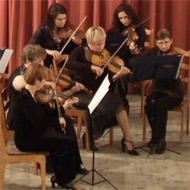
|
|
The complete suite as played by the Smolensk Chamber Orchestra
Duration: 4'24" direct link to YouTube
(the Folia starts at 2' 51")
© 2012 by The Smolensk Chamber Orchestra |
|
The complete suite by Alejandre Prada
Direct link to the IMSLP.org
© IMSLP
|
An orchestral adaption of the sarabande by Händel for harpsichord solo as the second movement of a suite: Suite para cuerdas, Op.37 (composed in 2009?) consisting of the folllowing parts: 1 Danza española, 2 Folia, 3 Vals marinero, 4 Marcha, 5 Preludio, 6 Finale
- Smolensk Chamber Orchestra conducted by
Yuri Sobolev
- Title: La Folia
- Sheetmusic published by IMSLP in 2009
- Duration: 4'09"
- Place and date of the recording not mentioned in the documentation but the YouTube file was published in 2012 and the mp3 soundfile was made available at IMSLP in 2013
- Bartoli, René (guitar and arranger) 'Récital de guitare'
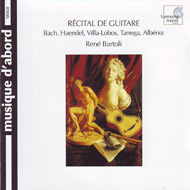
- Title: Sarabande
- Released original 1971 by Harmonia Mundi, this series Musique d'Abord 1999 compact disc HMA 190 928
- Duration: 4'28"
- Recording date: unknown
- Blanchette, Peter (11-string arch guitar and arranger) 'Style Brisé'
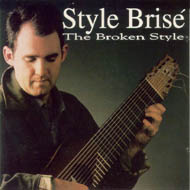
- Title: Sarabande 'La Folia'
- Released 1991 by NCB compact disc SBCD001
- Duration: 9'47"
- Transcription: Peter Blanchette
- Recording date 1991 (not indicated in the slipcase) in
St. Peter's Basillica, Shelburne Falls, MA USA
- Canadian Brass 'Bolero and other classical blockbusters'
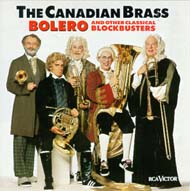
- Title: Sarabande for strings & basso continuo
- Released June 1995 by BMG/RCA compact disc ordernr. 68109
- Duration: 3'41"
- Recording date unknown
- Canning, Andrew (organ) 'Great European organs No. 78, Andrew Canning plays the Ruffatti organ of Uppsala cathedral, Swedent'
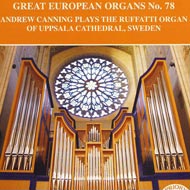
Normally I would have made a separate entry for this arrangement of Arno Landmann (1887-1966). But since the Sarabande by Händel
is already a remote derivation of the Folia theme I have clustered it into the lemma of Händel.
The piece was altered several times by Landmann and was published after his dead in 1977.
- Title: Variations on a theme by Händel, Op 29
- Released 2009 by Priory compact disc PRCD1010
- Duration: 14'05"
- Recording date: March 2 and 3, 2009
- Instrument: The Ruffatti organ of Uppsala cathedral, Sweden
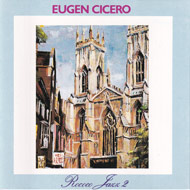
- Cicero, Eugen (piano), Henk Haverhoek (bass), John Engels (drums) 'Rococo Jazz 2'
 s'
s'
- Title: Sarabande for Angélique (from Suite No. 4 G.F. Händel)
- Released 1989 by Timeless CD SJP 255
- Duration: 4'30"
- Recording date: June 6, 7 and 8, 1987, at Fendal Sound Studio, Loenen, Holland
- G.F Händel mentioned as the original source
- Connor, Bill & Christiansen, David
 'Classical Trailers'
- Connor, Bill & Piggici, Lorenzo "Classical Trailers (CAVT 21)'
- Escala 'Escala'
- Title: Sarabande
- Released
September 2008 by Syco B002A61U1U
- Duration: 2'38"
- Recording date:
The album was recorded mainly at London, UK
- This cover band from the UK mentioned G.F. Händel as the original source of the music.
- At YouTube:
https://www.youtube.com/watch?v=oDq_ohinnn0
- Globus 'Epicon'
 Phil Gibbs wrote 20 March 2019 about this track:
This is by a group called Globus and is in symphonic hard rock, almost metallic, format. Globus is part of Immediate Music, a music production company specializing in trailer music for movies, commercials and other commercial uses. They are part of a new music genre called Epic that started in the 21st century. The particular piece of theirs is called “Sarabande Suite” and is from their first album (2006) – Epiconld.
Texts:
Globus Sarabande Suite
Es-tu libre Vraiment libre? As bien de Aeternae Penser.
Est-il phantome qui habité approcher de Aeternae Bien se calmer
Earthly prophet Break free, high Dreamless, hoping Set wings to fly
Earthly prophet Break free, high Dreamless, hoping Set wings to fly
Hoping, Dreaming Angels Take our bounty to the near world
Hoping, Dreaming Open With our hearts and minds to heaven
Oh, lost seekers Forget All the values of past eras
Oh, lost dreamers Find hope In the valley of the promise!
Amen All men are free Faith found Amen
Amen All men are free Faith found Amen
Amen All men are free Faith found Amen
Amen All men are free Faith found Amen
Amen All men are free Faith found Amen!
Earthly angel Hold me, Forget Angel terrestre Tiens-moi, regrette
Forever free Au l'âme va aide Eternal vie Au l'âme va aide
Eternal vie Au l'âme va aide
Eternal vie Au l'âme va aide
- Title: Sarabande Suite
(Aeternae)
- Released 2006 by Immediate Music compact disc
, re-relased by Imperativa Records
2014
- Duration: 7'46"
- At YouTube: https://www.youtube.com/watch?v=6YsY-s47_C8 track 13 at 59:50
- Recording dates and place unknown
- The Great Wee Band (Henry Lowther: trumpet and flugelhorn, Jim Mullen: guitar, Dave Green: double bass, Stu Butterfield: drums 'The Sound of Music'
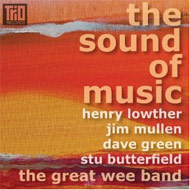 Mark Gardner, wrote for the Jazz Journal:
Handel's Sarabande is accorded a respectful treatment, with a notable contribution from Dave Green, who confirms all over this session that he is among the top elite of European bassists. He works hand in glove with the measured, intelligent drumming of Stu Butterfield.
- Title: Sarabande
- Released March 2010 by Trio Records compact disc
TR584
- Duration: 5'56"
- Transcription: The great wee band
- Recording date: unknown
- Jacques Loussier Trio (Jacques Loussier (piano), Benoit Dunoyer de Segonzac (bass), Andre Arpino (drums) 'Baroque Favorites'
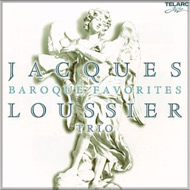 In the slipcase is written:
The disc opens and closes with sparkling works by George Frideric Handel. Loussier admits that the opening work,
the Sarabande from Suite No. 11, is one of his favorites, where the format of theme and four variations allows him plenty
of scope for invention. After a simple statement of the theme, Loussier takes full advantage of the form, employing a
mixture of gentle swing, walking bass lines, syncopated piano chords, and a persuasive Latin beat from drummer Arpino
to bring the variations to life.
- Title: Sarabande and Variations I, II, III, IV (Suite No. 11)
- Released 2001 by Telarc compact disc CD-83516
- Duration: 6'08"
- Transcription: Jacques Loussier Trio
- Recording date: unknown
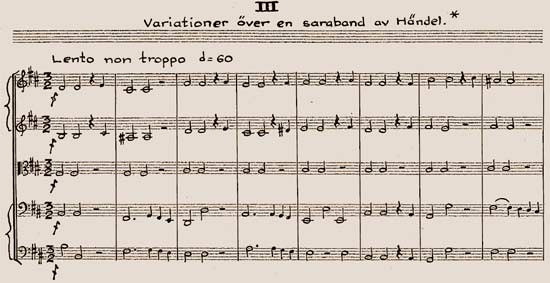
- Kempe, Harald D. (1900-1974)
Normally I would have made a separate entry for this arrangement of Kempe. But since the Sarabande by Händel is already a remote derivation of the Folia theme I have clustered it into the lemma of Händel.
| The opening of the third movement |
Published by Svensk Music |
 |
|
Example of the sheet music, Sinfonietta da chiesa for String Orchestra
© Svensk Musik Swedmic AB [SMIC]
|
- Title:
Sinfonietta da chiesa for String Orchestra; 3rd movement: Variations on a Sarabande by Handel [from the Suite in D minor HVW 437]
- Published by Svensk Musik Swedmic AB [SMIC] ID #16210
- Duration: c. 8'00"
- Year of composition unknown
- Kipnis, Igor (harpsichord) 'Showpieces for harpsichord'
|
|
Sarabande as played by Igor Kipnis
Duration: 4'24" direct link to YouTube
© 1970 by CBS |
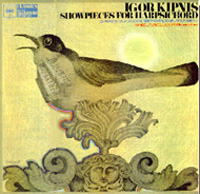 Judith Robison wrote as introduction for the track:
Among
other duties, Händel was much in demand as a harpsichord teacher.
In 1727, he assisted in the publication of his second book of suites,
which he entitled 'Lessons for the harpsichord'. The Sarabande, from the
fourth suite in this volume, is deceptively simple looking on the printed
page. In this recording, it has been embellished and elaborated according
to the style of the period.
- Title: Sarabande in D minor from Suite No. 11 in D minor,
Bk II
- Released (c. 1970) by CBS Classics LP 61132
- Duration: 4'20"
- Klass, Myleene (piano) 'Moving on'
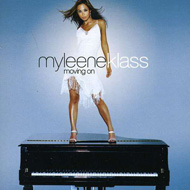
- Title: Suite For Keyboard (Suite De Piece), Vol.2, No.4 In D Minor, HWV 437: Sarabande (in an arrangement for orchestra)
- Released 2003 by UCJ Music – 986 563 2
- Duration: 3'34"
- Recording date:
unknown
- At YouTube https://www.youtube.com/watch?v=sXfqBPtPMG8
- Krapp, Edgar (harpsichord) 'Georg Friedrich Händel, Die Cembalowerke'
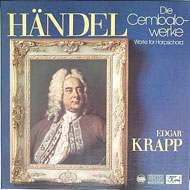
- Title: Saraband (und Variationen 1-2) from Suiten für Cembalo, Zweite Sammlung von 1733, Suite Nr.4 d-moll
- Released in 1981 or later (not indicated in the documentation but the lastest recordings were made in 1981)
by Ariola Eurodisc GmbH, München 8 LP-box 302 571 till 578
- Duration: 2'25"
- Recording date: 1978 in Erbdrostenhof in Münster, Germany
- Instrument: Virginal von Andreas Ruckers 1620 from the collection 'Musée Instrumental du Conservatoire Bruxelles',
restored by Kurt Wittmayer 1978.
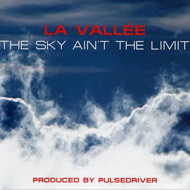
- La vallée 'The sky ain't the limit'
|
|
The sky ain't the limit
Duration: 3'17" direct link to YouTube
© 2007 by La vallée |
In the genre of House music/Pop trance
- Title: The sky ain't the limit: 6 tracks with all the Händel sarabande as theme with mentioning G.F. Händel as a reference of the music
- Released 2007 by
Storm Germany order number 881226182820
- Duration: Single vox mix 3'57", Classic vox mix 3'30", Extended version 5'
35", Single instrumental 3'56", Voice of trance club remix 6'24"
- Recording date:
not mentioned in the documentation
- Laganà, Ruggero (harpsichord) 'Follie, bizzarrie e stravaganze in musica, dal '500 all '800'
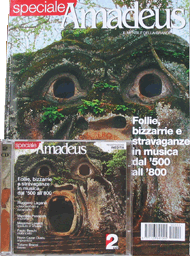
- Title: Sarabanda e variazioni dalla Suite in re minore per clavicembalo
- Released 2005 by Amadeus Darp, Milano, Italy double compact disc AMS 092-2 DP together with a
magazine special devoted to the Folia Theme (April 2005)
- Duration: 4'43"
- Recording date: August 18-19 and November 15-19, 2004 in Chiesa di S. Maria Incoronata, Martinengo (Bg), Italy
- All variations nicely indexed
- See also the page Recommended Folia-recordings
- Lagoya, Alexandre (guitar and arranger) 'Op veler verzoek Alexandre
Lagoya'
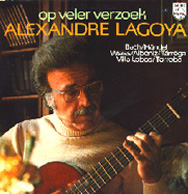
- Title: Sarabande in D
- Released 1971 by Philips LP 6833 159
- Duration: 5'00"
- Transcription: Alexandre Lagoya (published by Ricordi)
- Lagoya, Alexandre (guitar and arranger) 'Sarabande'
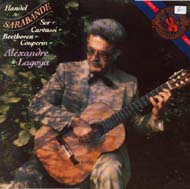 Indicated at the cover: George Frideric Handel's Sarabande is one of two
dance movements derived from a group of eight harpsichord pieces. The
thematic basis of the work is the familiar 'folies d'Espagne', an oft-quoted
theme from Spanish folk music.
Indicated at the cover: George Frideric Handel's Sarabande is one of two
dance movements derived from a group of eight harpsichord pieces. The
thematic basis of the work is the familiar 'folies d'Espagne', an oft-quoted
theme from Spanish folk music.
- Title: Sarabande
- Released 1983 by CBS LP D37787
- Duration: 4'45"
- Transcription: Alexandre Lagoya (published by Ricordi)
- Mastered 1983 from the original digital recording at
the CBS Recording Studios, New York
- Lubach, Arjen and Böhmermann, Jan
 Händels Sarabande is so popular that famous television personalities used it in a beat but to be sportiv they started the more popular orchestral arrangement to give people familiar with the theme a hint Waakop Reijers-Fraaijas are mentioned as the writers of the song.
|
|
Arjen Lubach and Jan Böhmermann
Duration: 3'25" direct link to YouTube
© 2024 Arjan Lubach |
- Verder naar rechts - Weiter nach Rechts
- Released March 2024 by VPRO television in De Avondshow met Arjen Lubach
- Duration: 3'25"
- Recording date: not mentioned in the documentation
- Mouskouri, Nana 'Classique'
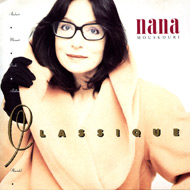
- Title: Gloria Eterna
- Released 1988 by Philips
836 593-2
- Duration: 3'55"
- Recording date and place not mentioned in the documentation
- Painter, Temple (harpsichord) 'Temple Painter, harpsichord recital'
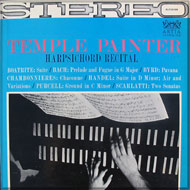 Temple Painter wrote as introduction for the suite:
In the Suite XI in D minor, we find Händel turning to the
past for inspiration. For a moment, he forgets his brilliant keyboard technique, and
with masterful style and a flair for illusion, he deftly transforms the harpsichord
into a soft and persuasive lute.
A gently undulating allemande and rollicking courante seem to serve as a prelude to
an extraordinarily beautiful sarabande. (No more beautiful expression than this is
to be found in the whole of Händel's keyboard works.) Almost as an afterthought, the
little gigue ends the suite with a bit of humor.
- Title: Sarabande in D minor from Suite No. 11 in D minor
- Released 1962 by Artia-Parliament Industries Classics LP ARTIA ALP(S)-198
- Duration: 2'36"
- Recording date and place not mentioned in the documentation
- Harpsichord with two manuals and three sets of strings varying in register and timber built by John Challis of Detroit, Michigan 1960
- Philharmonia Virtuosi conducted by Richard Kapp 'Super Hits of 1720'
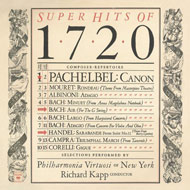 An orchestral adaption of a sarabande for harpsichord solo
- Philharmonia Virtuosi conducted by Richard Kapp
- Title: Sarabande from Suite No. 11 for harpsichord
- Previously released as Greatest Hits of 1720 (MK 34544) 1977)
- Released 2000 by Sony Music SFK 89123
- Duration: 3'30"
- Place and date of the recording not mentioned in the documentation
- RAM 'Kingdom of dreams'
|
|
RAM
Duration: 6'59" direct link to YouTube
© 2014 Trance Records |
Händels Sarabande is so popular that it even made it to trance music (without mentioning the source) in a 100% copy. The actual theme starts at 0'59". As listed by the younger generations unfamiliair with the oeuvre of Händel:
The track opens with a choir of vocals and dark, ominous string, before unloading into a pick-me-up melody topline and building into an all-out excitement break (source: Mixjunkies)
- RAM
- Released 2014 on A State of Trance records, part of Armada and is also going to be featured on Armin van Buuren Mix Compilation catalogue number ASOT249
- Duration: 6'59"
- Place and date of the recording not mentioned in the documentation
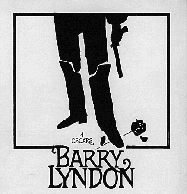
- Rosenman, Leonard (conductor and arranger) 'Barry
Lyndon', soundtrack of a film by Stanley Kubrick.
|
|
National Philharmonic Orchestra
Duration: 4'11" direct link to YouTube
© Leonard Rosenman and Warner Brothers |
This orchestral adaption
of a sarabande for harpsichord solo takes four different shapes: Sarabande
main title 2'38", Sarabande-duel 3'11", Sarabande-duel 48",
Sarabande end title 4'07". This arrangement was used several years
as tune for the dutch radioprogram 'Boeken' (VPRO).
- National Philharmonic Orchestra
- Released 1975 by Warner Brothers Records vinyl BS 2903
- Duration: Sarabande Main Title 2'38", Sarabande-Duel 3'11" Sarabande-Duel2 0'48" Sarabande End-Title 4'07"
- Place and date of the recording not mentioned in the documentation
- Ruigrok, Han (two Vaatstra-guitars)
| |
Duration: 3'06", 2.9 mb (128kB/s, 44100 Hz)
© 2011 Han Ruigrok, used with permission |
- Title: Folía in a minor
- Released 2011 by Han Ruigrok
- Duration: 3'06"
- Recording date March 2011 in the Netherlands
- Schenkman, Byron (harpsichord) 'George Frideric Händel, harpsichord variations'
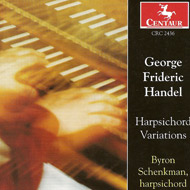
- Title: Keyboard Suite No. 4 in D minor, HWV 437, III. Sarabande and Variations, "Folia"
- Released 2000 by Centaur Records compact disc CRC2436
- Duration: 2'24"
- Place and date of the recording unknown
- Sgrizzi, Luciano (harpsichord) 'Haendel, l'Oeuvre pour clavecin, volume 1'
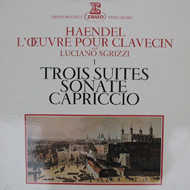
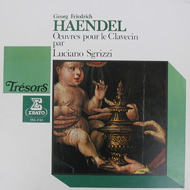
Marc Vignal wrote for the slipcase:
The Suite in D minor, no 4 of the 1733 set, was composed not later than 1718, most probably earlier. Fotr it also exists,
in an old manuscript published by Chrysander in the XIXth century, with a Prelude that eventually found its way into the 1720 set,
but restored here by us to its original place. This Prelude is followed by the four dances traditionally found in a Suite; among
these, a magnificent Sarabande with variations.
- Title: Sarabande avec variations (Suite in D minor edition de Halle II, 4. Crysander XI)
minor
- Released 1973 by RCA ERA LP ERA 9068 and 3-vinyl box RCA ERA 9190
- Duration: 4'29"
- Recording date: May 1972 in l'Eglise de Bregazona-Biogno, Switserland
- Instrument: Sperrhake (written as Sperrhacke in the single vinyl release)
- Tiësto 'Elements of life'
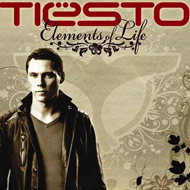 Händels Sarabande is so popular that it even made it several times to trance music.
Except for the opening of the song and the ending of the theme, this is another full copy of Händels Sarabande.
On the wikipedia page http://en.wikipedia.org/wiki/Elements_of_Life Tiësto, Geert Huinink DJ Waakop Reijers-Fraaijas are mentioned as the writers of the song.
|
|
DJ Tiësto
Duration: 3'34" direct link to YouTube
© 2014 Black hole recordings |
- DJ Tiësto
- Released 2007 by EMI compact disc order number Magik Muzik CD 07
- Duration: 8'25"
- Recording date: not mentioned in the documentation
- Vliet, Herman van (organ) 'Herman van Vliet, St. Joriskerk Amersfoort'
Normally I would have made a separate entry for this arrangement of Arno Landmann (1887-1966). But since the Sarabande by Händel
is already a remote derivation of the Folia theme I have clustered it into the lemma of Händel.
The piece was altered several times by Landmann and was published after his dead in 1977.
- Title: Die Variationen über ein Thema von Georg Friedrich Händel
- Released by Festivo compact disc FECD 128 (year of release not mentioned)
- Duration: 14'05"
- Recording date: not mentioned in the documentation
- Instrument: Naber organ, St. Joriskerk Amersfoort, The Netherlands
- Wolfe, Paul (pedal harpsichord) 'When they had pedals, Volume 2, The
Rutkowski'
- Title: Sarabande Variée from Suite No. 11 in D
minor
- Released July 1998 (original tapes remastered) by Lyrichord
Discs (Lyrichord Early Music Series) compact disc LEMS 8034
- Duration: 6'41"
- Recording date: 1958 as one of the first stereo recordings
- Instrument: nine-feet long pedal harpsichord (with a
sixteen-foot stop) built by Rutkowski in 1958
- Wright, Laura( vocals) 'Sound of Strenght'
- Title: Sarabande
- As composers mentioned G.F. Händel, John Heywood, Paul J. Geissinger
- Released 2014 by Decca 4811212
- Duration:3'39"
- At YouTube: https://www.youtube.com/watch?v=K7vdbi5OCrU
- Recording date:
unknown
- Yates, Richard (arranged sheet music for the guitar) 'Sarabande con variazioni', the transciber's Art, No 27.
This arrangement in a lower register (in the key of a minor) than the demanding arrangement by
Greg Motlasz (in the 'Folia-key' of d minor) is much easier
to play with all the open strings.
- Title: Sarabande con Variazioni
- Published October 2004 by the magazine Soundboard Vol. XXX, No 2.
- Pages 52-53, with an introduction and examples in sheet music p. 51-52, theme and two variations
- Size 29x23 cm.
- Holst, Gustav (1874-1934)
- The Planets, Saturn suite
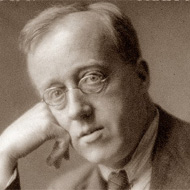 (the bringer of old age)
In the bars 44- 51 of the Saturn Suite the melody lines of the 3 flutes and the bass flute in G play the melody in a 4/4 meter, with chords changes within each bar. The 8th bar does not end in the tonica as in the standard Folia.
|
|
BBC Symphony Orchestra
Duration: 9'38",the Folía fragment starting at 3'45" till 4'19".
Direct link to YouTube |
- Adrian Boult premiere in Queen's Hall, London
- Published in 1915
- Duration: c. 9'30
- Performance date: 29 September 1918
- Kodály, Zoltán
(1882-1967)
- Galántai táncok
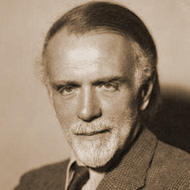
What makes the folía recognizable? Is it the melody, the chord progression, the rhythm or a combination of these ingredients?
For the alert listener the Folía sequence of melody notes derived from the progression of (folia) chords can be heard in a fragment of Galántai táncok as Arjen Bax pointed out:
In the fragment of the recording of the Wiener Philharmoniker conducted by Daniel Barenboim the strings play the melody at 15'18", closely followed by the trumpet. It might be coincidence but in a syncopated manner (a delay of half a bar) one can perceive the Folía theme.
|
|
Wiener Philharmoniker conducted by Daniel Barenboim
Duration: 18'08",the Folía fragment starting at 15'18". Direct link to YouTube
© Wiener Philharmoniker conducted by Daniel Barenboim |
- Wiener Philharmoniker conducted by Daniel Barenboim
- Released at YouTube by magischmeisjeorkest
November 7, 2011
- Duration: 18'08"
- Recording date: September 4th, 2007
- Krommer, Franz (real name
František Vincenc Kramář) (1759-1831)
Movement II Andante allegretto
from symphonie nr. 3, (Grande sinfonie pour 2 violons, flûte, 2 haut-bois, 2 clarinettes, 2 bassons, 2 cors, 2 trompettes, timbales, alto & basse) composed in 1807.
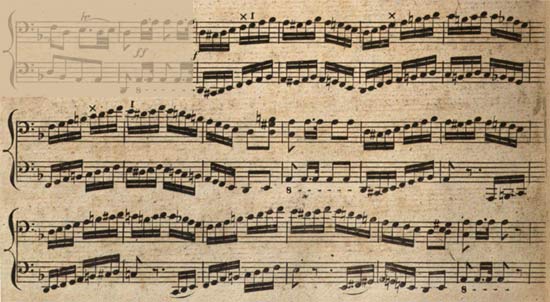
The theme can be heard twice in total 16 bars in a row.
The opening is exactly the first 6 bars of the Folia-theme. The ending is a bit more complex. This suggestion was made by Ryan Varum.
| An arrangement of the theme by Krommer |
source IMSLP |
 |
- Orchestra della Svizzera Italiana.'Division Musick, conductor Howard Griffiths.
|
|
Orchestra Della Svizerra Italiana
Direct link to YouTube
© 2017 by CPO |
- Title: Andante allegretto from symphonie no. 3
- Released 2017
- Duration 5'59"
- Purcell, Henry (1659-1695)
- One of the visitors suggested that Purcell was influenced by the Folia-theme
and in his oeuvre it is often recognizable. He wrote some interesting thoughts
about the relation between Purcell and the Folia-theme:
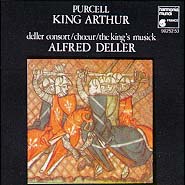
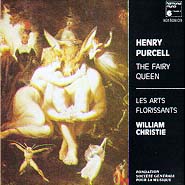
As I told you, Purcell often manipulates the original folia
theme to put it to more extensive musical use (probably to allow for some
more variety, although I think I could keep listening exclusively to folias
for months): the King Arthur Air could be the closest thing he ever wrote
to the original folia (while it is true that keeping a minor chord on the
fourth bar makes for a colder and less passionate folia); unfortunately
I am no Purcell-connaisseur either and I have no clue about other 'real'
folias in his works.
On the other hand, I'd like to stress the fact that the influences of the
folia on Purcell's music as a whole are incredibly vast (I would almost
be tempted to say the is not a single Purcell work I've listened to which
didn't contain a similar theme, or a directly inspired one); but as you
said, considering all of these similar themes as folias would devaluate
the collection. Anyway, the Fairy Queen probably based on that theme, not
on the original folia. As for the differences between the original folia
and that theme, I think you got it right, and that really makes a big difference,
in spite of the strikingly similar results obtained.
Listening again to both pieces I find that the fourth bar's progression
is quite similar, since they both seem to come back to I, even in the Air
(besides being a minor chord, it seems like the tonic to my perception),
which probably would lead us nearer to Purcell's vision of the folia (which
we should, perhaps, call 'Purcell's theme' rather than folia?).
- Air from King Arthur (Second Musick, 1691)
- Deller Consort and Choir - Alfred Deller, dir. and The King's Musick
- Released 1987 by Harmonia mundi compact disc HMC 90 252/53
and cassette HMC 40 252/53
- Duration: 0'55"
- Recording Date: 1978
- Chaconne from Act V The Fairy Queen (1692-1693)
- Les Arts Florissants, Christie, William, director
- Released 1989 by Harmonia mundi compact disc HMC 90 1308.09
- Duration: 2'40"
- Raff, Joachim (1822-1882)
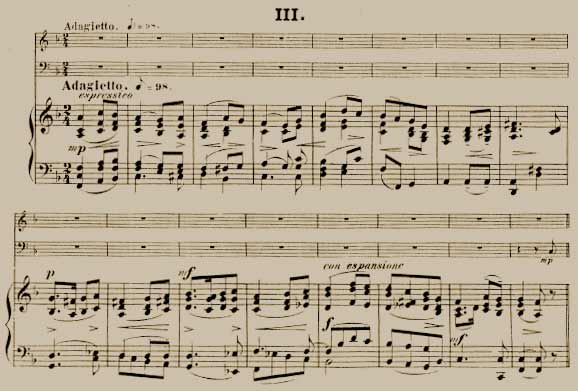
- Adagietto (third movement) of Piano Trio No. 3 in A Minor Op. 155 (composed in 1870, published in 1872)
A very nice theme in 16 bars similar to the Folía theme worked out in lots of variations (some very identical to the Folía theme) for piano, violin and cello, where each instrument takes its part with virtuoso solos.
Alexandre Charitopoulos wrote about this piece:
From what I hear, the beginning is really the progression of the Folia, especially at 15'59" in the YouTube performance of Trio Opus 8. However, it does not come back to the initial tonic (G minor here), so it is not "genuine". It is my opinion though that the Folia reference is pretty obvious.
- Trio Opus 8 'Joachim Raff, Piano Trios 2 & 3'
|
|
The complete Piano Trio No. 3 in A minor Op. 155
Duration: 32'24", opening of third movement at 13'45" direct link to YouTube
© 2011 by unknown artists |
- Released 2001 by CPO compact disc order number 9998002
- Duration: 9'10"
- Recording date unknown
- Tibaldi, Giovanni Battista
(16??-1736)
- Suario di otto battute a l' imitatione del Corelli Del Sig. Tibaldi (for
violin and b.c.)
Fred Hauptman wrote me a few years ago about this particular composition:
He was a Roman violinist of the late 17th century who had
contact with Corelli. He left two sets of trio sonatas, Opus 1 and 2. There
could easily be a Folia in these. Opus 1 was published by Garland in facsimile
(probably not in print), and there is a CD of excerpts from opus 1 and 2
(CPO 999 633-2; Parnassi musici) which however does not have a Folia setting
In December 2004 Helmut Timpelan wrote in much
more detail about this composition:
Das "Suario di otto battute a l´imitatione del Corelli Del Sig.
TIBALDI", ein aus 69 Teilen bestehendes Variationswerk für Violine
und Basso continuo über zwei ostinate Bässe, welche, (wie Andreas
Moser <1859-1925> in seiner "Genesis der Folies d´Espagne"
formuliert),"zueinander im Verhältnis von Vorder= und Nachsatz
stehen", hat ganz sicher Corellis zwölfte Violinsonate ("Folia")
Op. 5 zum Vorbild.
Denn wie ich nach eingehender Untersuchung erkenne, spaltet Tibaldi den
ostinato-Bass seines achttaktigen Vordersatzes, aus den ersten acht Takten
von Corellis ostinato-Basses ab. Corellis ostinato-Bass, der ersten acht
Takte, besteht aus zehn Noten. Aus diesen zehn Noten löst Tibaldi sechs
Noten heraus, nämlich die Noten 1,2,7,8,9,10. Und verbindet diese dann
miteinander. Aus dieser Verbindung, entsteht Tibaldis neuer 4 Takte langer
ostinato-Bass. Da nun Tibaldi diesen ostinato-Bass wiederholt, besteht sein
achttaktiger Vordersatz aus: 2 x 4 (Takten), oder 2 x 6 (Noten).
Die Melodie welche Tibaldi zu seinem ostinato-Bass erfand, also das Thema
zu seinen Variationen, kann man im Prinzip schon als erste Variation des
ursprünglichen Folie-Themas ansehen*.
Corellis zwölfte Violinsonate Op.5 ist also der Urprung bezw. die Urquelle
für Tibaldis auf zwei ostinaten Bässen fußendem Variationswerk.
Und deshalb können Sie mit gutem Recht Tibaldis "Suario di otto
battute a l´imitatione del Corelli" in dem Kapitel "Similar
Music" erwähnen.
Tibaldi bildete zwar, wie gesagt, aus acht Takten Follia-Thema eine neue
Melodie, trotzdem bleibt, , auch in allen Variationen über den achttaktigen
Vorderatz, das Follia-Thema permanent im "Hintergrund" ** präsent.
Soviel zu Tibaldis erstem achttaktigen (2 x 4) Vordersatz.
Nun noch kurz zu Tibaldis zweitem achtaktigen Nachsatz:
Dieser Teil fußt, wie ich sehe, auf einer, (im Rahmen des Diapason),
absteigende Terzen-Sequenz. Ganz sicher war Corellis charakteristisch absteigendes
Terzenintervall, Takt 7 im Bass, der Auslöser für Tibaldis weiterführende
großräumige Sequenz. Allerdings dieser zweite eigenständige
Teil hat keinerlei Ähnlichkeit mehr mit Corellis Follia.
Deshalb hat Andeas Moser unrecht, wenn er in seiner "Genesis der Folies
d´Espagne schreibt, Tibaldis Variationswerk würde sich "nach
jeder Richtung hin als Nachahmung von Corellis zwölfter Solosonate"
erweisen.
*
Für Tibaldi's Variationen 35 (über Vordersatz) und 36
(über
Nachsatz) dürfte die englische "Sailors Hornpipe" (holländisch "Horlepiep")
Modell gestanden haben. Das wird besonders in Variation 36 offenkundig. "The
Sailors Hornpipe", ein synkopierender Tanztypus, fand auch Eingang in Suiten,
Kammer-, Orchester- und Bühnenmusik von Purcell, Händel und Telemann.
**Das Kapitel III in "Gödel, Escher, Bach..." von Douglas
R. Hofstadter heißt und behandelt: "Figur und Hintergrund".
Im übertragenen Sinne: Tibaldis neue Melodie = "Figur". Das
Follia-Thema = "Hintergrund."
-
Federico Guglielmo (Baroque violin) and L’Arte dell’Arco (Francesco Galligioni Baroque cello · Diego Cantalupi theorbo/Baroque guitar Roberto Loreggian harpsichord/chamber organ) 'Albinoni. The late violin sonatas'
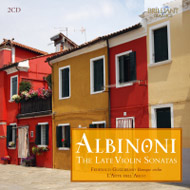
In the slipcase is written about the piece:
The little-known Modenese composer Tibaldi, in his Suario, clearly models his massive variation movement 'a l'imitationo [sic] del Corelli' on the latter's Folìa variations in the same key (D minor). Particularly impressive is Tibaldi's marriage of technical resourcefulness to musical inventiveness, the frequent dialogues between violin and cello being an especial delight.
- Title:
"Suario o Capriccio di otto battute a l’imitatione del Corelli" in D minor for violin and continuo (J.Roger, Amsterdam 1717ca) Adagio, Variazioni 2-69
- Released 2022 by Brilliant Classics 96402
- Duration:15'05"
- Recording date:
17-21 February 2019, Oratorio dei Ricoverati, Este (Padua), Italy
- Producer, sound engineer and artistic direction: Matteo Costa
- Tiomkin, Dimitri (1899-1979)
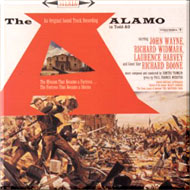
- The Green Leaves Of Summer, vocal and instrumental version as part of The
Alamo Suite (1960)
|
Duration: 2'49", 15 kB.
The Green Leaves of summer as sequenced by Olivier S. Descamps and used
with permission
© 2003 Olivier S. Descamps |
Olivier S. Descamps wrote about this tune:
Dimitri Tiomkin often worked on John Wayne films like "Red River" and "Rio
Bravo", and even Wayne's non-Western movies "The High and the Mighty" and
"Circus World". When John Wayne came to create his showpiece "The Alamo" it
was therefore natural for him to turn to Tiomkin for the soundtrack. The
composer wrote a number of songs for the film (e.g. "The Green Leaves of
Summer") which in part emphasise the homesickness and the heroism of the
defenders. The soundtrack is most memorable for the stirring martial music
depicting the relentless advance of the Mexican army. When asked why a
Russian composer should be able to so easily depict the Wild West, Tiomkin
would joke that there was little difference between the Steppes and the
Prairies. Not a straight answer but the lessons in counterpoint at the St.
Petersburg Conservatory are evident during these scenes.
The first 5 bars of this 16 bars tune are similar to the chord progression
of the folia and the ending of the first line in the dominant 7th (bar 8)
is like a Folia, however the rest of the chord progression with its chromatic
progression (bar 7) is another statement.
The La Folia tune goes like (chord progression):
dm/// a7/// dm/// c/// f/// c/// dm/// a7///
dm/// a7/// dm/// c/// f/// c/// da7/ dm///
while the Green Leaves of Summer-tune has a similar progression:
intro (dm d) ; dm /a7 / dm / c7 / f / gm / e7 / a7 and after that progression:
d7 / gm / c7 / f / dm / gm6 / ais7 / a7
- orchestra directed by Danied A Carlin, performers unknown (it seems
that film-fans are not that interested in musical performers at all!)
- Released March 1995 by Sony compact disc B000002AN4,
original release date October 1960 LP Columbia CK66138
- Duration 3'34" vocal version and 3'34" instrumental
version
- Recording date: 1960
THE GREEN LEAVES OF SUMMER
A time to be reapin', a time to be sowin'.
The green leaves of Summer are callin' me home.
'Twas so good to be young then, in a season of plenty,
When the catfish were jumpin' as high as the sky.
A time just for plantin', a time just for ploughin'.
A time to be courtin' a girl of your own.
'Twas so good to be young then, to be close to the earth,
And to stand by your wife at the moment of birth.
A time to be reapin', a time to be sowin'.
The green leaves of Summer are callin' me home.
'Twas so good to be young then, with the sweet smell of apples,
And the owl in the pine tree a -winkin' his eye.
A time just for plantin', a time just for ploughin'.
A time just for livin', a place for to die.
'Twas so good to be young then, to be close to the earth,
Now the green leaves of Summer are callin' me home.
'Twas so good to be young then, to be close to the earth,
Now the green leaves of Summer are callin' me home.
- Valente, Antonio (1520-1581)
- Il Ballo dell'intorcia (1576)
This piece of music is more of a passamezzo but the variation technique is quite similar to the Folia.
Valente was a blind Italian organist and composer, who worked mostly in Naples as organist in the church of Sant 'Angelo a Nilo'.
His Intavolatura di cimbalo is one of the earliest publications for keyboard instruments,
for which Valente developed his own tablature notation.
|
Duration: 1'19", 8 kB.
© Paolo Agostini 2006, used with permission |
|
3 pages in pdf-format, 92 kB
© Paolo Agostini 2006, used with permission
|
|
|
Franco Bandera da Rovereto
Duration: 2'14" direct link to YouTube
© Franco Bandera da Rovereto
|
- l'Amoroso directed by Guido Balestracci 'Seconde Stravaganze, Venetian & Neopolitan Music for Consort of Viols - vol. II' '
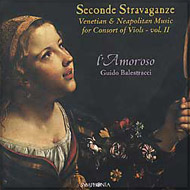
The Valente piece is used as the background for some texts in the setting for keyboard before an improviation starts off
for gamba's.
- Title: Tenore de paso e mezzo - Lo Ballo dell'intorcia
- Released 1999 by Symphonia compact disc SV 99170
- Duration: 4'33"
- Recording date: 1999 in Lucca, Italy
- Cera, Francesco (spinet) 'Antonio Valente - Intavolatura di cimbalo (Napoli 1576), Francesco Cera clavicembalo, spinetta e organo'
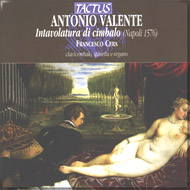
- Title: Il Ballo dell'intorcia
- Released August 2004 by Tactus compact disc TC532201
- Duration: 1'04"
- Recording date: March 18-19, 2003 in the Castello di Gargonza, Arezzo, Italy
- Instrument built by Roberto Livi, Pesaro 1999 as a copy of Dominicus Pisauriensis c.1550
- More about Francesco Cera at his homepage http://www.francescocera.it
- Ma i Bonet, Josep M.(organ) 'La cançó i la dansa en la música Hispanica d'orgue'
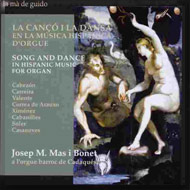
Josep M. Mas i Bonet wrote for the slipcase:
The Napolitan organist Antonio Valente, probably born in Portugal, composed the 'Ballo dell' intorcia' with a binary
rhythm, made up of 6 variations and 8 bars each, on a bass related to that of the Follia. It is taken from his 'Intabolatura de Cimbalo'
(1576), one of the oldest collections of music for keyboard composed in Naples.
- Ballo dell'intorcia
- Released 2005 by la mà de guido compact disc LMG 2069
- Duration: 1'47"
- Recording date: May 6 and 7, 2005 organ of santa Maria de Cadaqués, Spain
- Vitali, Tomaso Antonio (attributed
to) (1663-1745)
- Chaconne
In the entry of David and Vitali in Wikipedia is suggested that the Vitali Chaconne was most probably composed by the violinist Ferdinand David.
|
Duration: 3'41", 16 kB.
The theme and about half of all variations in an arrangement of Diepenbrock |
- Goldstein, Boris (violin) and Kühnl, Claus (?) (organ) 'Organ +
..Violine, ..Gitarre, ..Flöte, ..Englischhorn'
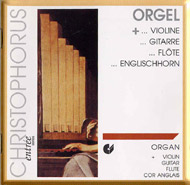
- Title: Chaconne für Violine und Orgel
- Released 1993 by Christophorus Entrée series compact
disc CE 0026-2
- Duration: 10'06"
- Recording Date: unknown (1977?)
- Haendel, Ida (violin) and Parsons, Geoffrey (piano) 'Baroque Transcriptions'
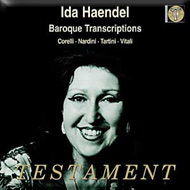
- Title: Chaconne
- Released 1977 by EMI LP ASD 3352
- remastered 2002 by SBT compact disc SBT 1258
- Duration: 12'44"
- Recording date: june 1976
- Huang, Bin (violin) and Kim, Hyung-Sun (piano) 'Baroque Violin Favorites'
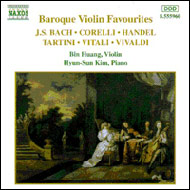
- Title: 'Chaconne'
- Released 2002 by Naxos compact disc 8.5558960
- Duration: 10'16"
- Recording date: unknown
- Marco (Aragón), Tómas (1942- )
 Throughout the piece there are weird percussion sounds (whooshing cymbals, woodblocks and rattles) which are easily
associated with steam engines, the breathing of a living being or the recording of Paniagua (1980, La Folia) as a quotation
of the literal meaning of the word Folia 'madness'. It makes the music very suggestive and powerful. In the opening of the
piece it is not that hard to hear the imitation of tropical birds with the glissandos on the recorder. The tone is set for
a playful but ambitious piece for full orchestra.
Throughout the piece there are weird percussion sounds (whooshing cymbals, woodblocks and rattles) which are easily
associated with steam engines, the breathing of a living being or the recording of Paniagua (1980, La Folia) as a quotation
of the literal meaning of the word Folia 'madness'. It makes the music very suggestive and powerful. In the opening of the
piece it is not that hard to hear the imitation of tropical birds with the glissandos on the recorder. The tone is set for
a playful but ambitious piece for full orchestra.
Some fragments of the Chaconne are only detected after the piece is heard at least once before. The descending
bass lines in the beginning are referring to things to come as an embryonal phase of the Chaconne.
The traditional Folia melody starts of in a weird harmonic context which gets its apotheose in an orchestral setting
which forcefully puts the melody in line (8'40"). Some short fragments are quotations of other Folia-composers as
the dramatic phrase by Howard Newton (12'33") which only lasts for the film score of 'Restoration' just to rearrange
the work in a very modern and twisted harmony.
The Chaconne which stands model in this composition is obviously the one attributed by Vitali. A full quotation of
the theme of this highlight in classical music starts at 14'00" with the melody line by the recorder and this section ends with the orchestral
version at 18'30". However the piece is fragmented and put together once more in an inventive way.
From now on the Folia and Chaconne get intermingled. The territories are set and in a playful game between orchestra and recorder
the piece develops with unexpected twists. The piece is much too lighthearted and friendly to speak of a battle in any
sense. Besides the two themes are expressions of exposure of sheer beauty not of associated with any kind of destructive
symbol.
The listener has all the reason to expect that the melodies will be in complete unity in the end and so they do with the recorder playing the
Folia melody and the orchestra the Chaconne (27'17"). A masterpiece that should be released as soon as possible
for the demanding listener to enjoy to the full extend.
Carlos Escalante wrote in a translation of an introduction to the Spanish radio
broadcasting:
This Madrid-born composer has a catalogue with more than
200 compositions that range from guitar and piano music to the most diverse
combinations
of instrumental, choral-symphonic and stage music. The work included in
this concert, "Vanitas con chaconas y folías" is the product
of a commission by the ORCAM that took place after
Marcó had already composed a work for Alvaro Marias, "Floreal 2" for
solo recorder. The idea of an orchestral work where the recorder was the
soloist instrument,
was fascinating for both performer and composer, and thus, the commission
of this work by the Madrid-based group generated this score, which,
as many other works by Marcó is strongly rooted in the Spanish culture.
According to the author, he wanted to create a musical "Vanitas" about
the pass of time and the vanities of life, following the same principles
found in some paintings and literary works of the Spanish baroque, as conceived
by Juan de Valds Leal o Antonio de Pereda. This explains an abundance
of baroque references that occur in many forms within the composition.
For instance, the use of an instrument linked to that period: the recorder,
of which three types are used: alto, soprano and sopranino.
Equally important, is the nature of the musical material with multiple
elements borrowed from the Chacona, as well as the theme of the Spanish
Folia.
In the composer's own words, the work does not follow a progressive development,
but is instead a juxtaposition (mixture) and a series of variations of
very well-defined
musical objects which are artistically modelled without losing their original
character. It is, according to Marco, a reflexion of the flow, recurrence
and inexorable pass of time, key elements in music.
| |
Duration: 0'55", 649 kB.(96kB/s, 44100Hz)
Fragment of Vanitas con chaconas y folías
© RNE, Orquesta de Córdoba conducted by Manuel Hernández Silva May 17, 2007 in the Gran Teatro de Córdoba |
- Orquesta de Córdoba conducted by Manuel Hernández Silva with soloist Alvaro Marías (recorder)
- Title: Vanitas con chaconas y folías (2006) commissioned by ORCAM
- Broadcasted by RNE (Spanish Radio) July 23, 2008
- Duration: 25'10"
- Recording date: May 17, 2007 in the Gran Teatro de Córdoba
- Milstein, Nathan (violin) and Blatt, Joseph (piano) 'The 1946 Library
of Congress Recital'
- Title: Chaconne
- Released 1996 by Bridge compact disc 9064
- Duration: 9'55"
- Recording Date: October 7, 1946 at the Library of Congress